FMP Research Strategy

Rose (2010, cited in Mannay 2016) informs us that ‘visual imagery is never innocent; it is always constructed through various practices, technologies and knowledges’.

Mannay (2016) advises:

‘There is a need to adopt a critical approach to reading visual images, one that thinks about the agency of the image, considers the social practices and effects of its viewing, and reflects on the specificity of that viewing by different audiences. As academics we need to question our own readings of images and narratives and in doing so recognise our own ideological commitments and specific ways of knowing.’

Caution, then, is needed in the selection and interpretation of any images used as research data, and in the production of any images resulting from that research, ensuring a true and fair representation of how the groups or individuals being studied perceive their environment – the aim being to evoke an empathic understanding for the alternative ways in which subjects view their world.

Two earlier projects, Cravings and Carousel, have examined alternative relationships with food.

‘Anorexia nervosa is an eating disorder characterised by restrictive eating and an intense fear of gaining weight. While anorexia is often recognised physically through excessive weight loss, it is a serious mental health problem’ (Mentalhealth.org.uk, 2018).

I want to visually describe the innermost thoughts which characterise this disease and by doing so help raise awareness – informing family and friends of the signs and symptoms which the addictive element of the illness compels anorexics to hide.

In essence, Ana as a Final Major Project will be a way for me to extend my knowledge and understanding, and that of others, through photography.

It is, therefore, my intention to produce a series of images illustrating the world is inhabited by those who suffer from anorexia. What are the factors which trigger anorexia, what factors operate to keep them in their world, and what factors operate to free them?

Importantly, how representative are the images which anorexics consume, seemingly with more enthusiasm than they consume food?

How strongly does the pro-Ana culture feature in the reinforcement of the eating disorder?

Items of food consumed by Marie are portrayed: from the standard-sized nutrient rich portions pre-illness to the sparse, nutrient poor items consumed during the days of her illness before the calorie-dense meals of recovery.

Personal possessions depict her interests and suggest the events that happen in her life.

Notes that she writes for herself, together with images she finds inspirational show the transition from good health to illness, and to recovery.

Research will draw upon the following sources:

Diaries written by recovered anorexics

The strong subculture is associated with anorexia and eating disorders in general

Laia Abril’s Thinspiration

Images of superthin models, images of anonymous anorexics, images taken of themselves by anorexics – the ubiquitous ‘selfie’

Online blogs and pro-Ana websites.

These can be identified as ‘found materials’.

‘In considering what can be found, and made the subject of social science inquiry, there are a plethora of existing visual and textual sources including print media, film, everyday cultural artefacts, personal communications, advertisements, internet, heritage sites and art works. Found materials position social scientists as image and narrative collectors, who then apply theoretical lenses to interrogate, examine and understand these objects of inquiry’ (Mannay, 2016).

What is the justification for my use of such sources?

Woolf (2015) informs us that western society has a problem – the glorification of eating disorders.

‘Even if you’re not actively looking for encouragement with an eating disorder, even if you avoid the internet altogether, you can’t avoid the overwhelming message of our age, that weight loss is good, weight gain is bad, that thinner (harder, leaner, greener) is better. We live in a hypervisual age, with most of us – especially the young – confronting thousands of images every day. The focus on women’s bodies is intense, in every magazine, website or TV advert, on every billboard and celebrity shot, and in the conversations of friends, mothers and sisters around us.

The effect can be profound, and yet still eating disorders are misunderstood. They are dismissed as a teenage, female condition (although male eating disorders are on the increase) or misrepresented as faddy dieting, body hang-ups, a phase they’ll “grow out of”. In fact, the opposite is true: eating disorders are highly addictive, and self-starvation becomes involuntary.

Anorexia has the highest mortality rate of all mental illnesses, more deadly than schizophrenia. One in five anorexics will die, either from physical complications or suicide’.

Wilson et al. (2006, cited in Johnson, 2015) inform us that ‘Pro-eating disorder websites host communities of individuals who engage in disordered eating and use the internet to discuss their activities’.

How prevalent is the use of such websites?

Custers et al (2009, ibid.) found that 12.6% (n = 90) of the girls and 5.9% (n = 42) of the boys from a sample group of 711 children and adolescents (7th, 9th, and 11th) grade had visited pro-anorexia websites.

Furthermore, a separate survey showed that 35.5% of 76 patients who had been treated for eating disorders in an outpatient clinic had visited pro-eating disorder sites (Wilson et al., 2006, cited Johnson, 2015).

There is further justification for using found materials as a data source, rather than generating data through subject participation. Anorexia is an addictive mental illness, and many factors act as triggers, perpetuating the illness: an inadvertent question, or a pertinent question asked inappropriately could trigger.

Furthermore, many anorexics hide their illness – compelled to do so by its addictive element, in some cases the illness is hidden from family and friends for years.

Those that do reach out for help become protected by the rules of patient confidentiality. An established track record of handling research with sensitivity, reverence and discretion is needed before clinicians will even consider approaching patients to volunteer for a research programme.


References

Johnson, Hadley A. (2015) I Will Not Eat – A review of the Online Pro-Ana Movement [Online]. New York: Adelphi University. Available at: https://www.semanticscholar.org/paper/I-Will-Not-Eat-A-Review-of-the-Online-Pro-Ana-Move-Johnson/b7a8b83bec0e6df021b83d4696ff8ac49c6819c8 (accessed: 09 February 2018)

Mannay, Dawn (2016), Visual, Narrative and Creative Research Methods: Application, Reflection and Ethics. Oxon: Routledge

Mentalhealth.org.uk (2018). ‘Anorexia nervosa’. Available at: https://www.mentalhealth.org.uk/a-to-z/a/anorexia-nervosa (accessed: 30 January 2018)

WOOLF, Emma (2015). ‘How social media is fuelling the worrying rise in eating disorders’. The Telegraph, 04 June 2015 [online]. Available at: http://www.telegraph.co.uk/women/womens-health/11649411/How-social-media-is-fuelling-the-worrying-rise-in-eating-disorders.html (accessed: 30 January 2018)
 

Devices, Moments, Contexts and Parameters

Mannay (2016) writes as follows: ‘Prosser (2006, p.17) contends that a photograph does not simply show us how things look, ‘it is an image produced by a mechanical device, at a very specific moment, in a particular context by a person working within a set of personal parameters’.

Reference

Mannay, Dawn (2016), Visual, Narrative and Creative Research Methods: Application, Reflection and Ethics. Oxon: Routledge.

On Reflection: Week 1, FMP

The beginning of the Final Major Project (FMP) provides an opportunity to reflect on progress since September 2016.

Initial objectives for the MA were as follows:

To explore the knowledge, technology and methods employed by the old Dutch masters to control light, and how the atmosphere and aesthetics of food images are influenced by light and various lighting styles

Research the knowledge relating to the elements of design that was available to the old masters

Rationalising the symbolism used by the masters, evaluating their reasons for its use as well as the sources of their information.

Module two saw this exploration continue but with two project themes: Ten (recording the meals consumed by ten school children on the same March evening) and Junk Food, it began to take on an aspect of visual anthropology.

Module three saw a strong focus on the visual narrative – examining the process of story-telling – and its application in the development of images.

Module four’s Work in Progress, Carousel, built on research from all the preceding modules.

In my view, module four was very successful and positions me strongly for the FMP.

Research (to date) for the FMP has gone well and initial discussions regarding the concept have generated significant interest. Test shots for the project have also proved to be very successful.

How, though, do I move things forward? Does my current work meet the requirement for a critically and professionally informed, resolved body of work?

Clearly, for the FMP, there has to be continued, progressive improvement – but this is true of any artistic output.

A certain ‘punchiness’ is required of the FMP output. How can this be achieved?

I need to explore techniques which take me further away from my comfort zone, for example, by allowing my work to be informed by the early still-life images of Irving Penn.

Is it time to move away from my original objectives?

Recapping, the intention for my project was to explore the knowledge and techniques used by the old Dutch masters, and to use the acquired knowledge to produce a series of food-related still life images.

I want to retain some link to this objective. I also want to remain true to my specialism by including an element of food in my FMP images.

My objective, therefore, is to present my FMP images in still life form. However, I am open-minded with regard to this and intend to explore alternative presentations. It has been suggested that an element of repetition is creeping into my work, I don’t necessarily agree with this suggestion and prefer to take an alternative view, which is that my work is making use of the rephotography technique used in social science and visual anthropological studies.

I think the research into the work of the old Dutch masters, which has brought me so successfully to my present location, is not something to abandon – moreover, it is something to use as a foundation, it is something to build on, for example by exploring the work of Meredith Frampton and how the principles of the verism movement can be applied to my work.

In the main, happy with progress so far.

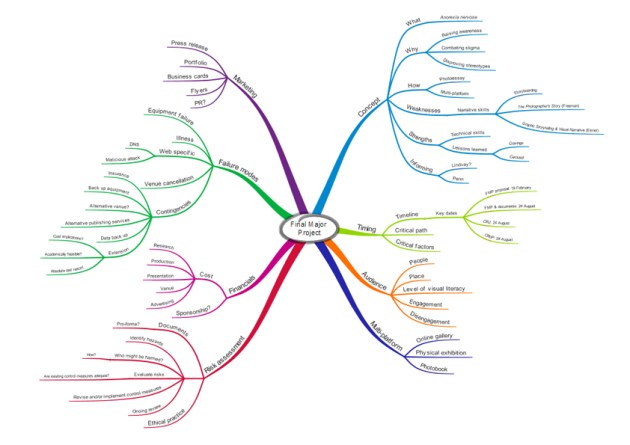
FMP Concept

At the start of the Final Major Project module (FMP), there are two options for viable research.

The first is alcoholism, the second is anorexia.

Both provide an opportunity to explore alternative relationships with food.

The initial idea was to produce a body of work based on research into alcoholism, this was the plan for quite some time.

The following are contemporaneous notes made as I externalise my decision to instead focus research on anorexia.

Arguably, anorexia, as a theme, is more relatable to food photography than alcoholism.

Food is a necessity, like water and air, we need it to survive.

But what happens when we start to regard food as a prison, trapping us in a body which we don’t want to be in, what happens when the balance of mind is affected?

What happens when our relationship with food turns sour, when food stops being a friend?

Jo is a recovered anorexic. She is a keen journalist and her diary keeping covers the period of her illness.

Diary entries record calorific intake and items of food consumed.

Freely admitting that her life has spiralled out of control, she lacks confidence and has low self-esteem.

What she eats is the one aspect of her life that she feels she can control and not eating provides her with a sense of achievement. It also helps her work towards her goal – being thin will lead to her being popular.

Pro-Ana websites have a significant influence upon her illness, and she finds that other users, mostly girls but not exclusively, refer to this as thinspiration and to themselves as ‘rexies’ and regard Ana, the vernacular term used by anorexics for the disease, as an (invisible) friend.

Consequently, the diaries also record phrases and images which were found by Jo to be inspirational.

Jo finds the culture associated with anorexia draws her deeper into a world in which she can be someone, a different person – the person she wants to be.

But this escapism has a price – denial of the reality which is the harm she is doing to her body as she starves herself.

Mental illness is heavily stigmatised and stereotyped – much work needs still to be done in educating people and reducing negative perceptions.

This holds true for eating disorders.

Anorexia is not a physical illness. It is a mental illness with visible physical symptoms.

Mental illness is not a taboo, it is not something to be hidden away – the most effective help we can all offer is to bring mental illness, irrespective of type, out into the open.

Such diseases are not something shameful, it is the way society regards mental illness that is shameful.

I believe that as photographers we have a duty to highlight social issues, to raise awareness.

‘Above all, life for a photographer cannot be a matter of indifference’ (Robert Frank)

I find food as a subject for photography enormously aesthetically appealing. The various ways in which we relate to our food fascinates me. Mental illness, how we regard those with mental illness and how we go about their treatment is a subject close to my heart. It is an area of considerable discrimination, ignorance and inadequate resourcing, all of which I have experienced first-hand as partner of, and carer for, someone with mental illness – including an eating disorder.

I want to know more about this mental illness and to understand more.

Jo-Ana is a way for me to extend my knowledge and understanding, and that of others, through photography.

Based on such close personal experience and a desire to further both my understanding and that of others, the project is being undertaken for both emotional and intellectual reasons (Scott, 2014).

I believe that this will be a cathartic process in addition to the outcome being a body of work which may help raise awareness.

What is the trigger? Are there multiple triggers?

Is there peer pressure before the influence of pro-Ana websites?

What – journal entries of a girl suffering from anorexia

How – still-life images

Why – raise awareness of the link between food and mental health, help remove the stigma associated with mental health issues


Reference

Scott, G. (2014), Professional Photography: The New Global Landscape Explained. Oxon: Focal Press

Irving Penn

Penn

Penn, 1985. Still Life with Triangle and Red Eraser

Irving Penn’s Still Life with Triangle and Red Eraser (1985) is a collection of largely incongruous, disparate objects.

The subjects, placed on a plain off-white surface, appear to be illuminated by a single light source.

Lighting is harsh with sculpted shadows and an immediate transition from light to dark – a trait seen in many of Penn’s still life images.

Why did Penn produce this image in this way?

The innovative, experimental nature of modernist art is clearly visible in this abstract image.

Characteristic throughout his career, with this still life, Penn is producing new imagery, in a new way for a new age.

As much as I like this image, it jars with me – there is a strong sense of dissonance in this image, I feel that this is largely because of the claustrophobic arrangement of subjects which, touching or overlapping, are left without space in which to breathe.

I don’t think this image, in terms of style, could be further removed from my photographic practice.

The suggestion that I examine the early work of Penn has been made.

Why? Phrased differently, how is this relevant to my photography?

I think the key point is to produce work which takes me away from that with which I feel comfortable, to take my photography in a new direction.

So, on the way to producing my final major project, there will also be some experimental photography.

My intention is to analyse Penn’s images in order to understand the techniques he employed so successfully. I will then endeavour to recreate some of his images before finally producing my own version.

To learn from such a master is first to analyse, then to imitate, then to apply in one’s own creations.

Sublime … Not So Ridiculous?

‘Theory developed by Edmund Burke in the mid eighteenth century, where he defined sublime art as art that refers to a greatness beyond all possibility of calculation, measurement or imitation’ (Tate.org, 2018).

Tate.org (2018) informs us:

‘The theory of sublime art was put forward by Edmund Burke in A Philosophical Enquiry into the Origin of our Ideas of the Sublime and Beautiful published in 1757. He defined the sublime as an artistic effect productive of the strongest emotion the mind is capable of feeling. He wrote ‘whatever is in any sort terrible or is conversant about terrible objects or operates in a manner analogous to terror, is a source of the sublime’.

This would appear to be in direct contrast with the definition provided by the Oxford Dictionary for the word sublime:

‘Of a feature of nature or art: that fills the mind with a sense of overwhelming grandeur or irresistible power; that inspires awe, great reverence, or other high emotion, by reason of its beauty, vastness, or grandeur’ (Oxford English Dictionary, 2018).

On one hand, sublime is seemingly used to refer to strong emotions associated with terror, on the other hand it is used to refer to awe inspiring greatness relating to some physical attribute including, but not limited to, beauty.

The two seem very much at odds, both statements cannot be correct.

How do we reconcile this dissonance?

Before attempting an answer, I need to determine how this is relevant to my practice?

Previously I have described the observation and craftsmanship shown by Vermeer in producing the light fall-off in The Milkmaid as sublime. It has been suggested that my use of the term is incorrect.

I didn’t agree with this notion on the occasions that the suggestion was made, and I don’t agree with it now.

For me, the important thing is to recognise and accept that one definition of the sublime does not preclude any or all other definitions.

Use of the term, that is to say which definition of the term is used, is very much context dependent. And this brings me very nicely to my final point.

I think this discourse is also relevant to my practice from the point of increasing my visual literacy and associated vocabulary.

Vermeer painted in such a way that light has a presence, a vibrancy all of its own – it is awe-inspiring and, for me at least, retains the right to be described as sublime.


References:

“sublime, adj. and n.”. OED Online. Oxford University Press, January 2018 [Online]. Available at: https://goo.gl/SHcQgL (Accessed 25 January 2018)

Tate.org ca. 2018. Art Terms entry: ‘sublime’ [Online]. Available at: http://www.tate.org.uk/art/art-terms/s/sublime (Accessed: Thursday 25 January 2018)

On Reflection: Weeks 13 – 15, Module Four

A consolidated account of weeks 13 to 15, module four.


Week 13 – w/c Monday 08 January 2018

Building a website, a seemingly simple task!

Started in September, it has been a saga of trial and tribulation.

I had a very clear outcome in mind, a very definite look that I wanted for the website which would represent my photographic practice.

Having tried many options for ready-made, template-based websites, the experience has taught me that a website designed and up and running in minutes is nothing more than a marketing ploy.

WordPress has served me very well during the life of this CRJ – I am impressed. Nevertheless, I was unable to obtain the freedom I wanted to customise my website even with a self-hosted .org.

And to be honest, I quickly found myself out of my depth.

Be clear on this, WordPress is a very powerful application for the design of websites. Any constraints on my ability to customise were a direct result of a lack of knowledge on my part.

New Year’s Day 2018, I made the decision to tackle the issue which had plagued me for some months. Locked away for six days, I taught myself everything I needed to know to be able to use WordPress child themes.

The results of my efforts can be seen here:

http://philipmorrisphotography.com/

The website isn’t complete (will it ever be?) and is subject to further development.

It has received positive comments from peers and from Lynn Chambers (MAYN Creative).

I’m proud of this achievement and the website closely matches my original intention.

I think it gives me a very strong platform from which to build my photographic practice.

Very positive feedback was received from Amy Simmons, MC Saatchi, regarding the treatment I prepared (see Receiving Treatment). In summary, she felt that all the information contained in the treatment was correct with a nice level of detail.

Moving forward, Simmonds suggested that images which provide inspiration for one aspect of an image are placed together in one separate section, with a separate section being included in the treatment for each aspect, e.g. images relating to lighting, texture or background.

Additionally, images which are included for positional illustration should be labelled as such. Positional illustrations being favoured over mock-ups, the latter possibly placing a constraint on creativity by preventing the opportunity to experiment with different arrangements during the shoot.

Again, another achievement to feel positive about.

Week 14 – w/c Monday 15 January 2018

Results!

The effort has paid off.

I am very pleased with the results for the assignments submitted 15 December 2017.

These results build very nicely on earlier marks.

Looking back 12 months and there is a marked difference in the feedback provided by the academic staff – last year I was a mess, floundering.

I am looking forward to working on my final major project.

With regard to my project, the Christmas break was an opportunity to evaluate both concept and plans.

The result was a major rethink – the theme for my final major has changed quite significantly.

Initially, it was the intention to explore alcohol dependency. I think there is a lot of mileage in this theme as a project.

To be honest, the concept met with mixed reactions, but most were negative.

My revised plan is to explore what happens when our relationship with food becomes unhealthy – in this looking at anorexia.

Week 15 – w/c Monday 22 January 2018

Rejection is part of being a photographer – fact.

Nevertheless, it can be a very bitter pill to swallow.

There have been a lot of positives in recent weeks – positives that I can continue to build on. I don’t know if that made a rejection this week harder to accept.

Is it a major rejection? No, not by any means – but it still got under my skin.

Inspiration can come in many forms, and from many different areas.

‘Let me tell you something you already know. The world ain’t all sunshine and rainbows. It’s a very mean and nasty place and I don’t care how tough you are, it will beat you to your knees and keep you there permanently if you let it. You, me or nobody is going to hit as hard as life. But it ain’t about how hard you hit, it’s about how hard you can get hit and keep moving forward. How much you can take and keep moving forward. That’s how winning is done.’

– Rocky Balboa

I don’t need to beat anyone else. I just need to conquer myself. Then, and only then, I will have beaten everything.

A very productive week, focussing on project planning. There is clearly a long way to go, the project is deliverable at the end of August, but I feel that the concept is quite developed.

Forward into module 5 …