Further Questions of Authenticity

Should a “peculiar” nature of photography exist, does it influence how we view and subsequently interpret photographs?

In their 1975 article “Photography, Vision and Representation”, Snyder and Allen question whether photography is so different from other forms of visual art, with particular reference to painting, as to require its own unique methods of interpretation and standards of evaluation.

Certainly photography is unique in having the ability, once the correct camera and lenses have been chosen and appropriate settings made, to record a scene “as is”, an ability that is not available to painting where everything is dependent upon the knowledge and skill of the artist – assuming that he or she wishes to record the scene faithfully and not be “creative”.

“Most people, if asked, would no doubt say that, whereas the painter can paint whatever he wants, the photographer must depict “what is there.”” (Snyder and Allen, 1975, p. 148).

Arnheim suggests that the “mechanical” nature of photography confers upon photographs “an authenticity from which painting is barred from birth”: “All I have said derives ultimately from the fundamental peculiarity of the photographic medium: the physical objects themselves print their image by means of the optical and chemical action of light”. (Arnheim as cited in Snyder and Allen, 1975, p. 146).

Cavell suggests that the photographic process: “does not so much defeat the act of painting as escape it altogether: by automatism, by removing the human agent from the act of reproduction.” (Cavell as cited in Snyder and Allen, 1975, p. 145).

An interesting view is being put forward by Cavell, but it is a point of view with which I cannot agree.

A camera will always record exactly what is presented before the lens. What is presented and how is a matter of choice on the part of the photographer. A brush will only ever paint what is present in front of the artist as it is perceived by the artist.

Price seems to write in support of Cavell: “We speak of taking photographs rather than making them, because the marks of their construction are not immediately visible” (Price, 2015, p. 123).

But what might these “marks” be, and how visible are they?

In real-terms, the very act of taking a photograph leads to a distorted reality: the overall mood of an image can be influenced by choices concerning lighting or whether to shoot in colour or black and white, the choice of perspective can determine, as Snyder and Allen suggest, whether the same subject dominates or is dominated by its environment. Choices over which film to use or how to post-process digital images can lead to artefacts which may add an aesthetic quality to an image but may also detract from fidelity: a colour-cast or graininess which is peculiar to a particular brand of film or post-processing method.

There are, then, restrictions to how accurately a photograph can capture “reality” which arise from the photographic process.

All this, then, leads to a question which I feel is often overlooked: how real do we want photographs to be?

Snyder and Allen inform us that there are two discrete schools of thought: the “scientific division”, and the “art division” (Snyder and Allen, 1975, p. 144).

Price et al discuss important movements with origins contemporaneous with the formative years of photography: “straight photography” (akin to naturalism or realism), and pictorialism (Price et al, 2015, pp.  15 – 17).

I think how real we wish the images we make (as photographers) and view (as an audience) is very much context dependent.

Photojournalism is a genre where integrity is paramount and today we might place this type of photography into the “straight photography” camp.

Some genres of photography, on the other hand, lend themselves more readily to images which are not just manipulated but constructed purely for artistic purposes, fine art, for example, which might fit the pictorialist ideology.

In order for audiences to maintain faith in the photographic establishment, it is of vital importance for photographers to appreciate their intended audience and supply the kind of images that the audience expects – being clear as to whether the context demands the provision of images with a high level of authenticity, or with a high level or creativity.

So then, are there any characteristics of photography which make it deserving of unique methods of interpretation, standards of evaluation all of its own?

Arguably not, because surely the rules of interpretation are universal across all forms of art. Whilst that may be the case in terms of visual appearance, what of the technical nature of photographs.

Other forms of art have their own technical terms, for example, paintings imprimatura and grisaille terminology. And so exists terminology to describe, in standard terms, the way photographs are taken in the same way that we might analyse the brush strokes of an artist in order to understand the techniques he or she applied in the painting of a piece of art.

Whilst a unique system of interpretation may not be necessary, several attempts have been made to develop a universal method of evaluation: semiotics, for example, has been and continues to be applied equally well to the analysis of photographs as it has and does to paintings.

Pierce introduced the philosophical system of semiotics in his book “Logic as Semiotic: The Theory of Signs” (1910), a discourse on the theory of language and reasoning. This system has since been utilised widely in attempts to establish the nature of photography and photographs.

Barthes, Sontag, and Snyder and Allen have all referred to terminology introduced by Pierce in his system of semiotics in their attempts to qualify how photography “exists”, such terminology as: icon – the resemblance a photograph has to its subject, index – trace evidence of the existence of a subject once photographed, and symbol – an agreed, standardised point of reference which can be used as a basis upon which to form discussions that are inclusive (e.g. a car is a car because that is what we are taught, and it is universally accepted that a “car” will have a chassis, four wheels, an engine, etc.).
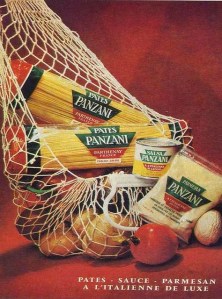
panzani

“Panzani” Advert used by Barthes to explore the “rhetoric of the image”

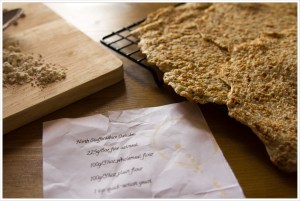
Moving on, my photographic practice is currently split into two areas. Firstly, the commercial photography where images might be sold to food retailers and caterers. This is an area where a relatively high degree of reality is expected on the part of clients and the final audience. Images which are created can quite often be a new take on already established idea – letting the client and the final audience see something old in a new way. The purpose of such work is to highlight the appeal of food or drink and establish in customers a desire to purchase.

This is in contrast to my second area of work, that which is related to my project. Here images are created to have aesthetic appeal whilst conveying a message associated with our relationship with food. These images are “constructed”, in real life the images do not exist – whilst individually the subjects are tangible objects, they are brought together and arranged in an appealing manner purely for the purposes of making the image.

For these two areas, the context is different – requiring different things – and so the intent is different. The output in each case, however, is true to the intent.
oatcakes

Morris, 2016. Oatcakes

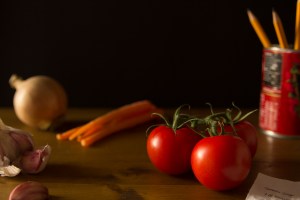
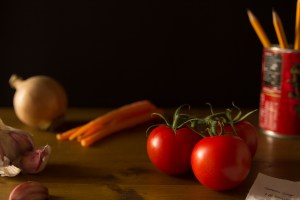
tomato-soup

Morris, 2016. Tomato Soup

It is this dichotomy, being able to produce images that are true to the real world on one hand, whilst creating images which are only representations of the real world on the other – the difference between a found image and a made image – that is the “peculiar” nature of photography.

What photography and painting share is that whether reality or fiction is portrayed comes down to choice on the part of the artist. This choice is very much dependent upon context, i.e. who will view the work, when, where and why. Where they differ is that in photography it is in the nature of photographic equipment to reproduce images with a high degree of fidelity to the original, in painting the degree of fidelity to the original is down to the ability of the painter in the use of brushes and paint.


Price, D. (2015) ‘Surveyors and Surveyed’, in WELLS, L. (ed) Photography – A Critical Introduction, Oxon: Routledge, 123

Price, D. et al (2015) ‘Thinking about Photography’, in WELLS, L. (ed) Photography – A Critical Introduction, Oxon: Routledge, 15-17

Snyder, J. and Allen, N. (1975) ‘Photography, Vision and Representation’, Critical Inquiry, vol 2, No. 1 (Autumn, 1975), pp. 143-169 [Online]. Available at: http://www.jstor.org/stable/1342806 (Accessed 03 February 2017)

A Question of Authenticity

‘In the Photograph, the power of authentication exceeds the power of representation’

– Roland Barthes

In deciphering what Barthes is trying to say, it is pertinent first to explore the meaning of the terms “authenticity” and “representation”.

Authentication is the term used to denote that an image is trace evidence of a subject having existed.  This equates to the “certificate of presence” referred to by Barthes (Barthes, 1980).

Scruton helps clarify the situation when he writes: “In other words, if a photograph is a photograph of a subject, it follows that the subject exists” (Scruton, 1981, p. 579).

Further clarification is provided by Tagg who writes: “What the photograph asserts is the overwhelming truth that ‘the thing has been there’: this was a reality which once existed, though it is ‘a reality one can no longer touch’.” (Tagg, 1988).

Authenticity, then, in a photographic context, deals with issues surrounding the integrity of an image, that is to say, how much faith we can place in an image.

As Price sums up for us: “perhaps the simplest and most obvious test of authenticity is to ask whether what is in front of the lens to be photographed has been tampered with, set up, or altered by the photographer” (Price, 2015, p.90).

Given that we now exist in a digital age where it is easy to manipulate images in an unprecedented way, how much faith can we place in the images that we see?

The fact that digital images, by their very nature, can be so easily manipulated – deconstructed and reconstructed even – raises questions as to the degree that what we are seeing is “authentic” or indeed “real” in anyway.

I think what we “see” in an image in terms of how truthfully it reflects a moment in time is very much context dependent.

There are some genres of photography where integrity is of the utmost importance, photojournalism being one example. Some genres of photography, on the other hand, lend themselves more readily to images which are not just manipulated but constructed purely for artistic purposes, fine art being an appropriate example.

Price informs us that it is the trace that is “considered to give photographs their special relationship to the real” (Price, 2015, p. 93).

So, what then of representation?

Representation deals with the particular way that subjects – whether they are individuals, groups or ideas – are portrayed by such visual modes of communication as painting and photography.

The term implies that images are not “innocent” but instead have their own ideological foundations and consequently “representation” is open to interpretation, both by the photographer at the time the photograph is taken and also by the viewer when looking at the image.

Just how open to interpretation “representation” is, just how ambiguous it can be, is highlighted by the following:

“The idea that the more transformed or ‘aetheticized’ an image is, the less ‘authentic’ or politically valuable it becomes, is one that needs to be seriously questioned …. To represent is to aestheticize: that is, to transform. It presents a vast field of choices but it does not include the choice not to transform, not to change or alter whatever is being represented. It cannot be a pure process in practice. This goes for photography as well as for any other means of representation”. (Strauss, 2003 as cited in Price, 2015, pp. 88-89).

So, what does Barthes mean by stating that the power of authentication exceeds the power of representation?

My interpretation is that Barthes is suggesting that whilst the reality regarding a subject can be misrepresented, the fact that the subject existed is undeniable.

But I think it goes beyond that. I think Barthes is trying to express that there is a form of hierarchy existing between authenticity and representation, with authenticity taking precedence over representation. After all, what is representation if that which is being represented is false? For the representation to have any meaning there has to be some authentication.

Do I agree with Barthes?

Well, yes and no.

Again, this comes down to the context in which any given image is viewed, and what expectations we associate with that context. When we look to be informed about world events, we expect the images that we view to have integrity which is beyond any form of doubt. Alternatively, we expect some images to distort an existing reality, or even to create a reality all of their own – fantasy art images meet this expectation.

How does this impact on my photographic practice?

I think it is important to operate within a framework of professional standards. Analysing “authenticity” and “representation” has highlighted the need to be aware of the appropriate time and place to offer work having the highest possible value as a documentary source and to be aware of the equally appropriate time and place to offer work that is, by design, fantasy. That is not to suggest that “constructed” images are made without integrity. The integrity of images, and hence the integrity of the photographer and the wider photographic “establishment”, is brought into question when “constructed” images are passed off, or “represented” as being authentic.

In summary, then, whilst recognising the need for artistic licence in some contexts, there is a direct link between “authenticity”, “representation” and the audience: horses for courses.

Barthes, R. (1981) Camera Lucida: Reflections on Photography. New York: Hill and Wang

Price, D. (2015) ‘Surveyors and Surveyed’, in WELLS, L. (ed) Photography – A Critical Introduction, Oxon: Routledge, 90-93

Scruton, R. (1981) ‘Photography and Representation’, Critical Inquiry, vol. 7, No. 3 (Spring, 1981), pp. 577-603 [Online]. Available at: http://www.jstor.org/stable/1343119 (Accessed 29 January 2017)

Tagg, J. (1988) ‘The Burden of Representation’ PhotoPedagogy [Online]. Available at: http//www.photopedagogy.com/john-tagg.html (Accessed 30 January 2017)

On Reflection … Week 1, Module Two

And onwards to Module Two.

Despite still not having fully recovered from the cold virus which decided to join the household at Christmas, the first week back to studying came as a welcome event.

“Where are you now?”

This was the first question out of the box for week one of module two.

And so followed a very interesting self-analysis of my photography, where it has been, where it is now and where I envisage it going in the future.

I have to say that I found this a good way to ease back into studies post-Christmas break. Feedback from fellow students was very insightful and most encouraging – certainly suggesting that my project proposal and associated work in progress is being viewed receptively (which certainly hasn’t been the case in some quarters).

Having established, or at least having had a stab at establishing, where I am, what next?

The next concept with which to wrestle was the ontological nature of my photographic practice.

In layman’s terms – what are the characteristics of my photography?

Not such an easy concept to appreciate. I think we are much more accustomed to thinking about our photographic “style” than we are of thinking about our photography in terms of “characteristics”.

I think the idea of how my photography exists, the form it takes, and how this translates into an “entity” appreciable by its characteristics is something that needs incubation, an idea that needs to germinate. This is something I intend to continue to look into because I think defining the “nature” of my photography is inextricably linked to further defining the audience for my work.

First thoughts, though, I think it both fair and accurate to say that I felt a degree of resonance with Szarkowski’s analysis of what a photograph is and how its “form” may change (Szarkowski, J. 1980. The Photographer’s Eye. London, Secker and Warburg).

On a different tack … …

In terms of my project proposal, I have continued to look into how the techniques of the great masters can be applied effectively in order to produce images which have a social relevance.

Why the need for a “social relevance”? Well, apparently, the concept of having a social relevance to my images is the strongest and most appealing facet of my proposal (incidentally, not a theory I necessarily subscribe to but I’ve picked up the ball and I’m running with it … …).

How do I happily marry these two concepts? This has been, shall I say, a “thorny” issue, at times a seemingly intractable problem.

Finding a “vehicle” which will successfully carry two seemingly different ideas, each of which could exist as discrete projects in their own right, hasn’t been easy, it’s taken some thought.

“The scales have fallen from his eyes.”

One possible narrative may be to look, progressively, at our relationship with food as it extends from production to consumption. This is an interesting area for exploration, and something I would like to look at closely – but in another time and another place.

Much more interesting for me (at least at the moment), is an exploration of the social, ethical and political issues associated with how we produce, consume (or do not consume) our food.

Oh, and not forgetting to mention that during the last week I saw an image which sparked an idea for a very different way in which some of my still-life images could be photographed. Something I am looking forward to experimenting with.

And finally … …

This week’s webinar was initially viewed with the usual level of trepidation. However, a new year and a new start … … and a new format.

Out with presentations, in with tutor-led question and answer sessions.

The new format was very unexpected. Most students had prepared the previously obligatory PowerPoint slides – the very small number that hadn’t had experienced technical issues preventing this. Initially, there was some slight vexation that the presentations wouldn’t be needed. However, there was unanimous post-webinar agreement that the new formula was a winning one.

Consensus was that the question-and-answer style made for a much more relaxed environment which, in turn, was much more conducive to learning. By mutual agreement, all students felt that they had taken something highly beneficial away from the webinar which had been a positive experience. This is most certainly true in my case.

Long live the new webinar format say I, a sentiment which I know is very much echoed by my fellow students!

The Characteristics of Photography

The ontological nature of my photographic practice … …

The “characteristics” of my photographic practice took some time and thought to identify: I think we are much more accustomed to thinking about our photographic “style” than we are of thinking about our photography in terms of characteristics.

Szarkowski identifies the “actual” as one of five characteristics of photography. By this he refers to the reality of the situation where the photographer decides to capture a specific moment in time, photographing what is there, and uses that reality to infer something beyond – that which is seen and that which is not seen.

Does this perceived reality apply equally to all genres of photography?

One area where it may not hold quite so true is that of still-life food photography where images contain an element of both selection and synthesis –  the photographer chooses the subject and its environment (selection) which are then arranged to produce a visually appealing composition (synthesis).

The still-life photographer can exercise control over almost every aspect of a photograph including, for example, the texture and colour of the background.

This is in contrast to some types of photography where the photographer has less control over the subject and its environment, for example, street photography where the level of “control” the photographer has over the subject and the environment is limited to where to frame up and when to press the shutter release (excepting post-production manipulation of course).

Time is also given by Szarkowski as a characteristic of photography. This ties in with Cartier-Bresson’s “decisive moment” where the photographer needs to decide when to operate the shutter mechanism: knowing when to press the shutter can mean the difference between “taking” and “making” a photograph. This implies a pre-obtained knowledge of events, for example, an awareness that a person’s image will be reflected in a window as they pass by a shop and knowing when to release the shutter in order to capture the person and their reflection.

You bring your own time to still-life photography. Images are constructed, possibly over lengthy periods of time taking into account the lapse between the initial spark of an idea and the final image being produced with small, incremental and progressive adjustments being made in order to achieve an abstract reality and add detail, another characteristic identified by Szarkowski, bringing authenticity to a less than real reality for the still-life photographer.

Shore describes prints as being “flat” and having “edges”. However, what I strive for as a photographer is realistic two-dimensional representation of a three-dimensional experience. Again, detail plays a large part in achieving this, as does the skilful use of photographic equipment.

As stated in “Photography, Photographies”, Szarkowski’s characteristics focus on the photographer. However, I feel it extends beyond that with many of the characteristics relating to the way we operate our cameras with timing, for example, being linked to shutter speed, framing being linked to focal length, and the “actual” and detail being closely associated with the framing of the subject.

Perhaps, then, Szarkowski’s “characteristics” are as relevant when we actually take a photograph, the physical process of taking a photograph, as when we think about how, when, where and by whom the image will be consumed.

At this juncture, my photographic practice is split into two discrete areas: commercial and project work.

To date, commercial work, has been undertaken on a project brief basis for small, independent organisations operating in catering and food retail. Consequently, contexts for this type of work have been printed work, magazines, promotional literature and websites.

This area of work is greatly removed from my project work, the contexts for which are mainly my CRJ to date with an online gallery being in development.

Evaluating my photographic practice in terms of characteristics has been an interesting and enlightening process for me, one which has certainly given me a lot to think about.

Where Am I Now?

Where is my current practice?

My area of interest is food photography. This genre of photography has a particular ability to appeal to me, to grab my attention – something resonates with me.

Food photography is ubiquitous with the majority of photographs being made to support recipes and, consequently, existing almost exclusively in recipe books and magazines. Comparatively, very few images are made to exist in their own right – as pieces of art.

Initially, the images I made fell into this category. OK, they were taken by me to be photographs of interest, the intention being for people to look at the images for their visual appeal and not purely to see how a recipe might or should turn out. But, the style was conforming to the generic “commercial” formula.

I want my photography to develop. I want my work to progress to a point where it successfully occupies a niche: to be different, unique, attention grabbing, visually appealing, going beyond a mere commercial brief.

It is my belief that images of food can, and should, exist as standalone works of art with a beauty and appeal of their own. To be different and make this kind of image has been a conscious choice.

I think I have found some success in being able to previsualise the images I want to make and subsequently achieve this vision – even if my images had a more “editorial” style in the early days.

Being self-critical isn’t something that comes easily to me. I know when I am satisfied with an image and it is of a standard where I am happy to look at my image myself and to share it with others. I also know when I am not. However, this has generally been an instinctive feeling as opposed to something rationalised and related to critical thinking.

So, being self-critical is something I have had to work at. Have my images “suffered” as a result, or more correctly, has my photographic progress and development been retarded by that?

Very possibly. And that is a weakness I am addressing.

How do I see my photography progressing?

First and foremost, I think it is important that I learn from my failures as much as I do from my successes. Ambiguity can be a good thing because, if you accept it, it forces you to interrogate things more thoroughly.

Elaborating on that, the feedback from the first assignments was most enlightening and has given me a considerable amount to think about.

With that in mind, I plan to continue to explore the knowledge and techniques used by the great masters to produce their amazing still-life images. This investigation will concentrate on three specific areas: the techniques and equipment they used to control light, their knowledge of compositional techniques, and their use of symbolism and their sources of knowledge for this.

Will this help me to successfully occupy a niche? On its own, possibly not and a lot would depend on execution.

I certainly think that this will help me to occupy a niche. My intention is to develop my storytelling ability. Yes, I want to produce beautiful images which have their own visual appeal, but that doesn’t mean that they have to be devoid of meaning.

Food is absolutely essential to our existence, that much is obvious but what may not be so obvious is that we seem to treat our food as a very “disposable” commodity – something largely taken for granted, the way we produce it and consume it (or not) raises some ethically complex issues.

Combining the results of my investigations into the work of the Dutch masters with subject matter which explores our relationship with food, using the former to support the latter, will allow me to produce images which are unique in their nature.

Additionally, I will experiment with post-production techniques with a view to giving my images a “painterly” aesthetic and have a plan to do this which includes, for example, the use of textures, underlays and overlays.

I have a target market in mind and I am researching this further, clarifying and defining the “audience” for my work. Additionally, I am researching how notable photographers have successfully defined their target market and subsequently presented their offerings.

still-life-with-cirtus-fruit-l

Morris, 2016. Still-life with Citrus Fruit

still-life-with-orange-and-walnuts

Morris, 2016. Still-life with Orange and Walnuts

tomato-soup

Morris, 2016. Tomato Soup

On Reflection … Week 15, Module One

A consolidated account of the Christmas break and weeks 13, 14 & 15 of module one!

Where has the time gone?

I’ll begin by saying that Christmas was not at all as expected with everyone, like so many others, succumbing to a particularly nasty cold virus. As a result no one, despite the build-up, was remotely interested in doing anything even slightly festive and so, we all took separate paths to our own little sanctuaries to suffer in silence.

I think next Christmas we will go out for Christmas lunch: let someone else have the planning, shopping, cooking and washing-up to deal with!

On the plus side, however, feeling rotten and not wanting to do anything created time to sit quietly and think about the course and the project.

Looking forward, feedback from the module one assignments provided a great deal to think about. My immediate thoughts were quite vexed, disgruntled. Whilst there was much to be positive about, the suggestions for future project development seemed to focus on issues which, in my view, had already been addressed to some degree by an appropriate form of practical activity and subsequent discussion.

But, it all comes down to perspectives doesn’t it?

It is absolutely crystal clear in my mind as to what it is that I am trying to achieve. And I believe I have communicated my intentions for the development of my project very well (within the constraints of format, time, word count, etc. imposed by the assignments).

But what I think I’ve communicated, and what I have actually communicated may not be the same thing.

That is to say, people may not be reading my words as I intended.

So, is there ambiguity?

Is my message abstruse? Subjective? Open to interpretation?

Pragmatically, my initial response was a very valid and natural one arising from the underlying wish to do a good job. Prima facie, I felt that there was some disparity between my efforts and the resultant feedback.

Criticism, even when it is well-intentioned and constructive, is not an easy thing to accept. It’s inherent in our nature to want praise and hear good things about ourselves and the things that we do.

But would I strive as hard if I had received the highest possible marks and feedback which only “showered praise”?

Yes, I believe I would. I know from personal past experience that I’m a very “driven” individual and like to excel at everything I do. However, that is almost irrelevant because we are each one an individual and as a result respond in our own unique ways. Additionally, our predominant personality type ebbs and flows: even the most “driven”, self-motivated individuals have some moments where they settle for something mediocre – it’s what we do 99% of the time that defines our personalities.

Consequently, we all have to be subject to the “carrot and the stick”, we all have to go through the same critiquing process. And in doing so we learn to become more self-critical and more accepting of the criticism of others.

Putting this wisdom (and feedback) to use … …

Looking back to September and the ensuing early weeks of the course, I can now see quite clearly the flaws that existed in the initial project proposal.

Hindsight? No, I don’t think so … …

A lot of our studies to date have focussed on developing skills to identify and assess different perspectives, and to critically evaluate both our own work and that of others.

This has made it so much easier to assess my own work, evaluating it for its strengths and its weaknesses.

As a result of the assignment feedback, the project has become more defined, more refined, both in terms of what it is, and what it is not.

The concept has become more “finalised”, research into the tools and techniques used by the great masters to control light, their knowledge of such compositional techniques as the golden mean, their use of symbolism and the sources of information for this will continue.

Progress in terms of where this knowledge should lead has been significant. A (perhaps) pronounced flaw in the concept in its earlier form was to what use would this new-found knowledge be put.

I had the seeds of ideas firmly sown in my mind. That these seeds were beginning to germinate as they were dutifully incubated, though, may not have been adequately communicated to others.

As already stated, the positive thing to come out of having a cold virus was an opportunity to think things through. The vision I hold for the output resulting from my research into the knowledge and methodologies of the great masters is currently mine alone – the project still requires much work over the next 18 months or so before it reaches a stage where it may be shared with an audience. Based upon my own internal vision for my finalised project, I believe that this work alone will be unique in its nature.

Notwithstanding the latter, I now have a much clearer vision of how to utilise the findings of my research whilst at the same time producing a body of photographic work has a “unique selling point”, of using this research to produce photographic images which convey a message and invoke a reaction.

Whether or not these ideas were adequately communicated or not raises some interesting questions … …

How does one communicate an idea which isn’t fully “matured”? Should one do so? Or, is it better to wait until the idea is developed, has integrity and can stand up to interrogation?

Again, perspectives.

The optimum solution, possibly, is to formulate a statement of intent, nothing more than one or two sentences, to “put a stake in the ground”, a clear signal that an issue has been identified and marked for, at the very least, future consideration.

In summary, this has been a very interesting and extremely valuable exercise.

To finish on a high point, discussions have been held with two parties who are very interested in my project proposal. One of which is an author and art historian with many published papers to her name, an expert in her field who is most willing to share her knowledge and experience as my project develops.

I am extremely grateful to both for their interest in my proposal, their highly positive feedback and their offers of support.

Next station call, “Module Two” … …

Where has the time gone?

On Reflection … Week 12, Module One

Putting the final touches to the research proposal and work in progress portfolio, two seemingly simple tasks, hasn’t left much time for other activities this week.

Labour under no misunderstanding, these are assignments and I am after every available mark. I was leaving nothing to chance. Presentation was absolutely everything.

I tend to use a subtle frame to set off my images, a small white border around the image with a very fine grey keystroke to demark the area. And, in my opinion it looks good – a small finishing touch to define the area in space occupied by my images, just as a frame sets off a physical painting or photograph.

Disappointing then, and frustrating, that when my portfolio was assembled and converted to .pdf file and given final scrutiny, the border became corrupted. The two sides and top were present but with artefacts, and the bottom edge of the border was missing completely.

A number of attempts to rectify this problem failed to produce anything different. No matter what I tried, the border became corrupted when the portfolio was converted to a .pdf.

So, the borders were disposed of. All images are now borderless. At least, on the plus side, this will prevent marks from being lost due to untidy presentation.

I think I need to do some research into why the problem occurred. Certainly, the time to look into the issue further before the assignment submission deadline wasn’t available. Furthermore, there was a job to do and, as much as I think the borders helped set off my images, giving them a point of reference in space, there was no benefit in sentimentality. I would, however, like to look into their continued use in the future. I can’t be unique in having experienced the problem, so, something to research.

Who is this CRJ for? An interesting question which arose this week.

Is it for an individual? If so, is that individual myself, or someone else?

If not for an individual, then what audience?

Let’s just pause for a while and evaluate what the acronym, “CRJ”, actually means. I think there is a lot of mileage in such an evaluation.

Critical Reflection Journal.

Ultimately, whatever name is used to refer to the act of “reflective writing”, the aim is to focus on writing which is not solely descriptive but also analytical.

My view is that this CRJ is primarily for an individual, me! It is about my progression through an MA in photography. It is to document the research I undertake, the things that interest me and those that don’t, the things that go according to plan and what I can do to ensure more of the same and build upon these successes, and the things that go wrong and what I can take from such experiences.

Note, the use of the word “primarily” … …

I have no problem with sharing my thoughts, or indeed salient aspects of my research with those who share an interest in my project. And for that reason, I am more than amenable to suggestions of how the CRJ might be made more “reader friendly”.

Again, as with so much recently, it all comes down to perspectives. But to what extent should personal perspectives be allowed to dictate? And should any one personal perspective be given precedence over another?

On reflection (see what I did there?), I think it isn’t what is said, it is the way something is said that can be so irksome. I certainly feel that is what has caused me vexation this week.

Let’s distil that idea … …

It isn’t what is said, it is the way something is said.”

What that distils down to, rather pragmatically, is this: “how is it meant?

What are the motives for the commenter? What are the motives for the comment?

Being a photographer is about having a point of view. I think there are times when you have to make a stand, when you have to defend your art or your view on art.

Describing an image or its use as “tiresome” doesn’t really benefit anyone, doesn’t really enter into the true spirit of critiquing and isn’t really best practice. Photographs have different meanings to different people. What appears as a “tiresome” image to one individual may be an important image for any number of reasons to someone else. For every image, there is an artist who invested time and effort, possibly other resources, into making that image and, as a consequence, it deserves respect.

Images, whether they are paintings or photographs, are intended to be looked at – repeatedly. It isn’t common practice to hang a picture on the wall on Monday, find it “tiresome” by Tuesday and change the image that hangs there on a repeated basis thereafter. Or is it?

Clearly a compromise needs to be found. So, yes, a CRJ needs to be a “reader friendly” entity. But not at the expense of all “individuality” rendering it “sterile” and “barren” and devoid of any opportunity to learn “reflectively”, after all, we are all individuals and we all learn in our own unique way – no two CRJs are the same. People include in a CRJ what has value to them at that time.

Letting all the dust settle, a lot of valid points have been discussed this week and a number of opportunities to make this CRJ more “accessible” have been identified and will be implemented.

One final thought on CRJs, perhaps there is a reason why any particular CRJ is the “way it is”. That reason, perhaps the learning curve relating to setting up and maintaining a CRJ is a steep as that relating to the subject of the CRJ itself (maybe even steeper).

From a personal point of view, I haven’t found WordPress the easiest of applications to use. I’ll be investing some of my downtime during the Christmas holiday genning up on WordPress and its wily ways.

Moving on … …

I have had two ideas for future images. Images which I am really excited about. Images which bring so much of my research and subsequent findings to date together in a cohesive manner. And there is plenty of scope to be creative and generate something really aesthetically appealing.

I’m looking forward to working on these images.

Being Self-critical!

Time to take a few steps back and be self-critical.

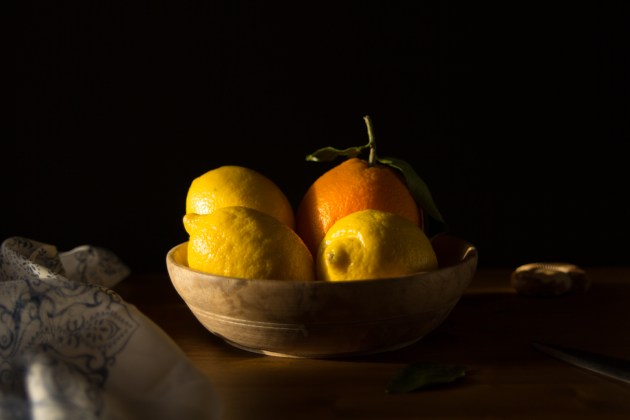
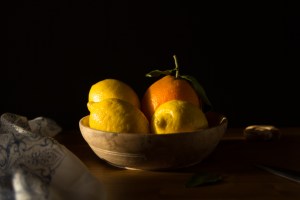
The image shown below has been given the title “Still-life with Citrus Fruit”. It was made as part of this week’s research into the methods used, if any were, to control light by the great masters.

still-life-with-cirtus-fruit-l

Morris, 2016. Still-life with Citrus Fruit

I think it has a strong, yet simple composition designed to show the exquisite texture and rich colours of the main subjects – an orange and lemons in a simple, hand-turned wooden bowl. A white scarf featuring an intricate blue pattern compliments the main subject and provides a degree of balance, as do an orange leaf, knife and an ammonite fossil.

The view point for the image is similar to that utilised by the great masters in many of their works. So, whilst it is not, in general terms, unique it does have a legitimacy arising from a tried-and-tested “formula”. Close-up shots are en voque in contemporary food photography and I wish to avoid producing images with such a perspective. What other perspectives portray the characteristics of still-life subjects to be displayed in such an appealing and “accessible” manner, laid-bare and nothing hidden? Or is there? What is hidden away in this image? What can’t we see?

That’s an area for future exploration.

The image was taken using only natural light. The location for the composition was chosen so that the subjects would be bathed in pools of warm mid-morning light. The split-lighting effect of the natural light provides contrasting regions within the composition, dapples of joyful bright colour in the highlight areas opposed by the dark moodiness of the shadow areas.

Note that the image is lit from the left. It was an interesting exercise to construct a “dolly”, a quickly conceived contraption upon which the still-life table could be placed in order to allow it to revolve 360 degrees around it’s rotation axis. Keeping all other variables constant, seeing the same composition lit from the right was quite revealing and is something I will expand upon at another time.

Does the image meet my expectations? Well, no actually. It exceeds my expectations. Is that selling myself short? No, I don’t think so because I “hoped” and planned accordingly to achieve a final image that had a high degree of aesthetic appeal and technical quality, but aiming to produce an image lit solely by natural light, did I “expect” the desired outcome.

I am, in short, very pleased with this image. That’s not to say I’m comfortable having arrived at this point. In fact, far from it. Having reached this juncture, I want to continue exploring, to see what is around the next corner. So, what can I do differently in future that builds upon this momentary success? Again, something for future exploration.

Does the image match my pre-visualisation? Yes, I was able to arrange the still-life with items I planned, in the way I planned. That’s an area I had a reasonable level of control over, unlike the environmental conditions. Which leads very nicely into my final point …

Were there any challenges involved in making this image? Most definitely. The image was taken on a day with very changeable weather conditions. Dark clouds producing rain for the main with intermittent spells of blue skies and sunlight meant that there was no guarantee of the warm mid-morning sun that I hoped for. In the end, being prepared and patient paid dividends.

Doesn’t it always?

On Reflection … Week 11, Module One

Who looks at my work? Why do they look at it? Why should people look at my work?

A week for thinking outside of my personal viewpoint and striving to see things from other perspectives.

This is something I have really taken apart this week.

Me, looking at them, looking at me.

Interesting to see how my project proposal looks from alternative views. And interesting to see how many differing views there are.

All this poses a whole new set of very pertinent questions.

How critical is my reflection? How does this enrich my learning? Does it enrich my learning at all? Does any of this even make sense to other readers? Who are the other readers? Does anybody even remotely care about the words I write? Will it make sense to me when I refer to it in the future?

The latter question I can reliably answer, eleven weeks in and looking back I see validity, and some integrity, in what I wrote earlier in the course and it still makes sense – I certainly don’t find myself pondering and asking “what on earth …”, I still know why I wrote as I did. Perhaps most importantly, I would now look for different, possibly more refined ways, possibly additional ways, to express my views on the same subjects.

Time to start smashing down a few walls!

Moving on to other matters … …

Referring back to the subject of perspectives, some interesting discoveries were made this week concerning Vermeer and the way in which he composed his works. A lot of valuable information there. Lots more to think about and potential to open up further areas of investigation.

Significantly more time spent on the research project proposal, reviewing and refining. Finally, I have something that reaches out to me, something that makes me feel a presence, something that stands by itself and which I have a quiet confidence in submitting.

Next stage in the process, more practical work … …

On Reflection … Week 10, Module One

Working on my research proposal this week has been an interesting and revealing challenge.

The challenge came in the form of “writer’s block”. Overcoming this inability to think coherently about anything in-any-way-whatsoever related to the project proposal, let alone attempt to write it down, was at times very frustrating. However, perseverance won the day.

Surprising that, no matter how well, how meticulously you record all your thoughts in a notebook, when you start to write up your notes in a meaningful way it just doesn’t seem to come together sometimes. I feel compelled to say that tiredness played a major role in that this last week.

Further challenges came as a result of obtaining resources, or more to the point, trying to obtain resources. Adding to the communication chain meant adding to the complications this week. It was reassuring to work with suppliers who were prepared to jump through hoops to fulfil orders and overcome issues.

It has been, and continues to be, an interesting experience to dig deeper into the subject of my project. Analogy, it is a bit like trying to unravel several bits of tangled string, identifying one specific strand and then gently working along its length as it meanders through the knotted ball of equally tangled compatriot threads, following its journey through to a natural end at which point a discovery is made.

Questioning why still-life photography appeals to me more than any other subject has revealed something very significant. A fairly simple question you would think, but, in reality, one which was not easy to find a robust answer that would stand up to any sort of interrogation.

Some genres of photography restrict creativity, beyond choosing an already existing subject, to the act of photography itself: for example, choosing a viewpoint and a corresponding angle of view, choosing an aperture setting and depth of field in order to capture “what is there” in an artistic way. Still-life food photography allows me to create what I photograph myself – putting my own personal creativity into both the subject and the photography. It is this extension of creativity, to a level found more commonly in painting than in photography, that holds great appeal for me.

A peer review of progress on the research proposal and the WIP to date was very informative – surprising how each of the four projects that were discussed had been refined and evolved in what seems like a long time but is, in reality, only a very short period.