Being Informed By … Johannes Vermeer

Johannes Vermeer, b. 31 October 1631, d. 15 December 1675.

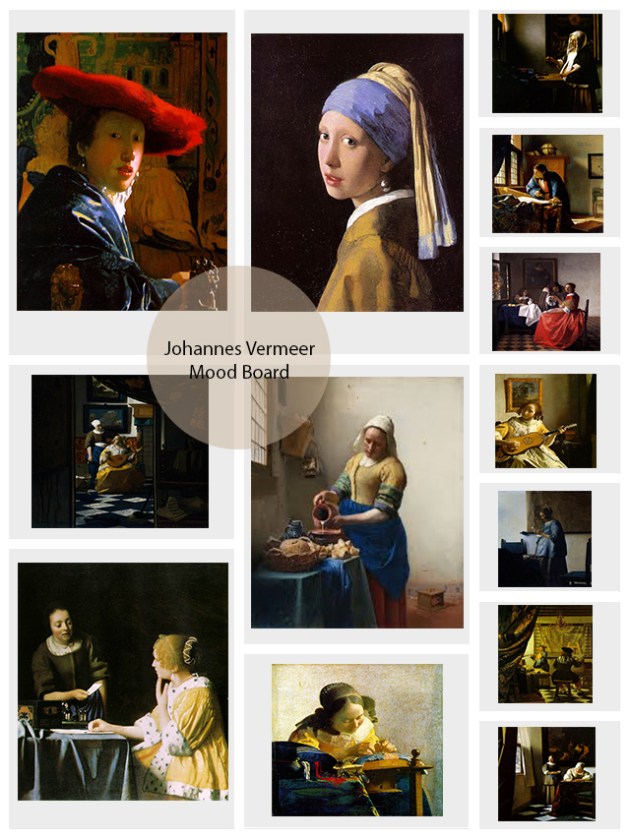
“The Master of Light”, Vermeer specialised in painting indoor scenes which depicted everyday middle-class life.

Vermeer’s ability to capture the way light illuminates objects, and to portray the texture of materials was astounding. For me, these qualities are awe-inspiring and unsurpassable.

The light fall-off on the back wall of “The Milkmaid” (1658) shows a tremendous level of observation, and a superb degree of craftsmanship.

Sublime … …

Vermeer_Mood Board _11Mar2017

On Reflection: Week 7, Module Two

Last week words failed me. This week, technology fails me … …

Least said.

On the plus side, I now have an (enforced) opportunity to start writing the Critical Review of Practice for the forthcoming assignments (deadline 1 May – as I write that’s seven and a half weeks away, the amount of work seems daunting and the available time feels tangibly like seven and half seconds …).

As it happens, I have a plan.

I found the work of German photographer Daniel Gustav Cramer very intriguing this week, images from the “Trilogy” exhibition portrayed a certain ambiguity which draws the viewer into them. I keep coming back to that, ambiguity – something to search for – makes for a better viewing experience, something the viewer wants to prolong.

Interviewed in 2010 by Klat Magazine, Cramer indicates the importance of recognising the “concept” underpinning each of his projects and how he views that concept as a roadmap, outlining the journey each project will undertake as it evolves – perhaps, then, “roadmap” is not the best analogy, more, perhaps, a “map of roads”?

Preparation for a forthcoming discussion on exhibitions has posed some interesting questions. It’s also precipitated me looking at contexts and audiences from (yet) another perspective.

What makes a good exhibition? What are the challenges in setting up an exhibition? What challenges are common to exhibitions irrespective of the media? And what challenges are unique to an exhibition of photographic work?

Is there a “rule of thumb” guiding the number of images for an exhibition? What determines this?

I found it very interesting to watch a video of a photographer preparing for an exhibition, and suggesting that a level of care is taken over the naming of images that are for sale at an exhibition. The value of using a simple name in order to direct the thoughts of potential buyers into thinking positively about the image, and to draw enthusiasm for the image, was firmly reinforced. In other words, avoid politically or socially loaded titles, or titles which make potential buyers think of mental images that they would rather their minds didn’t dwell upon.

It was also interesting to note that background neutrality was strongly emphasised, the gallery featured had neutral grey walls.

In terms of curating the images, psychological responses were alluded to, and it was discussed that viewers “typically enter an image through the lightest point near the frame”, their eyes then search around for a focal point which is typically the area of highest contrast, where the brightest whites meet the darkest blacks. Images are best arranged so that if anything leads a viewer’s eye out of the image, it does so by leading it into the next image.

All fascinating stuff and, of course, basic knowledge for photographer – but it’s always good to go back and revisit the basic periodically, just to keep the knowledge fresh in the memory and give a certain “grounding”. I think this separates how we read an image into two discrete areas: the first is how we respond to photographs in philosophical terms, and the second is our psychological response to images.

In relative terms, few people are aware of Barthes, Sontag and the whole bus load of other theorists. So, when the majority of images are viewed they are not looked at in terms of “icons”, “symbols”, “the signifier and the signified” and “surface, intended and cultural meanings”. Knowledge of these concepts is rather restricted to those who have been trained to think critically. What is common, however, to both those with and without training in critical thought, is a psychological response to the images they view.

This is something I really need to research in greater depth. Back to how some level of ambiguity, some level of us having been told something, but only just enough to pique our interest and leaving us to finish the story, makes for a more appealing image.

So, there we have it. A trifle earlier this week than normal, but I really am mindful of the deadlines for the forthcoming assignments and want to press on accordingly.

Wonder what next week will bring?

Hopefully, I’ll be in a much better position in terms of my Critical Review of Practice … …

(Did I tell you I have a plan … …?)

Jean Cazals – Positioning Practice

Paris-born Jean Cazals is a London based food photographer and winner of The Pink Lady Food Photographer of the Year 2012 award.

Without question a dominant player in the industry, how did Cazals become a photographer? “It’s like a lot of arts, you actually feel it, I don’t think you become one just by accident, making (a) living of it” he informs us.

And what does he suggest is the reason for specialising in food photography?

In an interview with ProductionParadise.com, he points out: “If you don’t like to love to eat then there’s no point being a food photographer” – applies to all forms of photography.

Barthes suggests that photographs are irrefutable evidence of the subject having existed: “In photography, I can never deny the thing has been there” (Barthes, 1993, p. 76).

Fontcuberta, however, reminds us that images can be false: “My mission is to warn people about the possibility that photography can be doctored…” (Fontcuberta in Bainbridge, 2014).

He goes on to state: “I use photography in the sense of it being an authoritarian tool. When we see a picture, we believe it is a picture of a fact, but this is just a convention” (Ibid.).

Credibility is something Cazals feels strongly is a key element in terms of being a successful photographer: “I’d say integrity, I think it’s integrity in everything you do”. He explains accordingly:

“You’ve got to follow the brief but you’ve got to follow the brief with your integrity. So, I think integrity and believe and love what you do is the main thing. Otherwise you become just a number doing something”.

Photographs in themselves do not narrate. Photographs preserve instant appearance” (Berger, 2013, p. 52).

In terms of appearance, the importance of unique personal style is something that Cazals is very clearly aware of, and utilises in establishing and maintain his niche: “don’t fall into the trap of trying to satisfy someone, you have to satisfy your client but you can satisfy with something that you like and you believe in. Because if this client comes to you, it’s because he likes what you do.”

Cazals is in great demand, with work being used in advertising campaigns, consumer magazines, food industry journals, and recipe books. Be in no doubt that this is quality work. But is it truly differentiated from the work of other contemporary food photographers?

Yes, I think it is. I say this because Cazals does indeed have a unique approach to food photography owing to his ability to demonstrate an “under-the-skin” understanding of his subjects. Understanding a subject on this level is one thing, conveying the characteristics of a real-world experience using two-dimensional medium is another. This Cazals achieves through the use of unique materials to bring in a range of colours and textures which, by comparing or contrasting with the subject, place the viewer in the frame. Consequently, images appeal as much to the senses of touch and smell as they appeal visually.

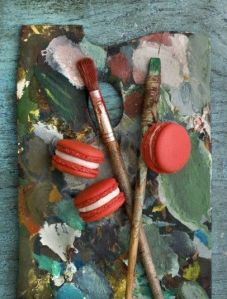
Cazals macarons

Jean Cazals, 2013. Cosmopolitan

Observing that “websites are the key of everything nowadays”, Cazals points to the internet being a significant factor in his promotional armoury, allowing him to reach a global audience. More specifically, he refers to the successful marriage between ProductionParadise.com and his own website: “because you show some example of your image then it goes forward to your own personal website”.

ProductionParadise.com is an online promotional tool for artists working in visual media. It may very well be the case that Cazals interview has been rehearsed as a promotional video, however, Cazals answers are consistent with sentiments he expresses in other forums and therefore have some credibility, which we have is important to Cazals.

At this juncture, as I prepare to write my critical review of practice, and in terms of my practice in general, Cazals interview underlines the need to identify and evaluate contexts for consumption.

Furthermore, it reinforces the importance of staying true to a personal vision, understanding that this is something which develops organically over a period of time. Undergoing constant evolution, being refined by personal experience, and informed by continuing critical contextualisation, but never redefined to meet the requirements of any one commercial brief – your style needs to remain exactly that, you own unique and personal style.


Bainbridge, Simon. (2014) ‘Spanish Lies’ in British Journal of Photography, 20 July 2014 [Online]. Available at: http://www.bjp-online.com/2014/07/joan-fontcuberta-interview-photography-exhibition-london-bradford/ Accessed: 03 March 2017)

Barthes, Roland. (1993). Camera Lucida London: Vintage

Berger, John. (2013) Understanding a Photograph London: Penguin

“Trilogy”

“Photography can only reveal the surface of things” (Ruff in Dorment, 2003). To find meaning in Cramer’s work we have to look, we have to search because, without doubt, these images are packed full of content. We need to scratch to reveal that which is beneath the surface.

Daniel Gustav Cramer’s “Trilogy” is an exhibition in three parts.

“Woodland (Trilogy Part One)” exhibited in 2004 and is a series of images which capture woodland landscapes. Nature moves very slowly – minute changes being made incrementally over a long period of time. Consequently, it is not the element of “freezing” a moment in time that Cramer brings to the subject, because, from our point of view, nature is pretty much “frozen” anyway. What Cramer’s photography does bring is a sense of nature having been left untouched by human intervention.

This is also true for “Underwater (Trilogy Part Two)”, and “Mountain (Trilogy Part Three)” exhibited in 2006 and 2007 respectively.

Interviewed by Chiara Parisi for Klat Magazine in October 2010, Cramer states that one intent behind his work is that of it being an archive. However, he goes on to say that whilst the archive is a “concept”, it is also merely an initial idea, a point from which his work can grow: “the concept is rather a starting point from where I can freely explore the potential that has been laid out” (Cramer, 2010).

Speaking more specifically about the “Trilogy” exhibition, Cramer points to the documentary value of his work:

“These days I probably spend an hour a day researching on YouTube and other sources into what is happening in the Gulf of Mexico right now. The worst thing, next to all the fatalities in the animal world, is that BP is not questioned or criticised. The media accepts things as they are.”

He goes on to state “Using photography to document nature as an abstractum is working so well.”

So, how can we, as viewers and photographers, interpret Cramer’s work?

daniel-gustav-cramer-mountain-09-domobaal

Daniel Gustav Cramer, 2007. Mountain 09

Frith (1997) suggests that there are three meanings associated with an image, and that these operate at different levels.

The surface meaning, the overall, initial impression obtained upon viewing the above image from Cramer’s “Mountain”, shows towers of rock which appear to show sedimentary layers. The rocks are surrounded by swirling mist, possibly cloud.

The intended meaning is what the photographer wishes to portray – this is the “preferred” meaning, the way in which Cramer “expects” viewers to interpret an image. Here Cramer is trying to portray a feeling of isolation in nature, but it is not an isolation that excludes the viewer, rather the ambiguity of exactly what it is that the viewer is looking at draws the viewer into the image.

Finally, the cultural meaning. The interpretation of this meaning is dependent upon the cultural knowledge and social background of the viewer. Cramer is showing us that much of the natural world remains unchanged by human activity, and in doing so reminds us of the great harm that is done when human activity does take place. He is providing a socio-political commentary in addition to documenting some of the world’s more remote places.

In semiotic terms, the rock towers are indexical in that they are providing direct evidence of this piece of landscape having existed, whilst the rock towers may not always exist, Cramer’s image provide trace evidence of their existence. Furthermore, the rocks are symbolic of the ruggedness of nature, of its ability to endure and, in cases where human’s drastically change a landscape as a result of their activities, to reclaim the “land” once human occupation has ceased.

Barthes (1977) makes reference to the signifier, something which is identifiable in an image and which conveys a denotational message, and the signified or the connotational (implied) meanings, ideas or ideologies which an image attempts to communicate to the viewer.

With reference to Cramer’s image, the signifiers are clearly the rock towers and the swirling mists. The signified could be an order, within a randomness, within an order. Natural objects, trees for example, are unique – it is a basic requirement that trees have leaves, but no two trees will have the same leaf arrangement – and this is due to randomness. Despite this, trees still conform to a basic body plan – a form of order – and it is this which makes trees recognisable as such. Alternatively, the signified could be the simple beauty of the natural world which is captured by Cramer’s abstract images, or it could be Cramer’s intention, by contrasting that beauty, to remind us of the damage we, as humans, do to the natural world in order to make it more “hospitable” for us as a species.

Again, it is this sense of ambiguity which makes Cramer’s images so appealing.

Something which is very striking, devoid of any artefacts of human existence, it is impossible to apply any sense of scale to the subjects in the Cramer’s images, despite the subjects themselves (trees, rocks, etc.) being easily recognisable features of a natural landscape.

Hodgson (2013) points out that we are familiar with discussing images as being “of something” but not so adept at seeing that images are also “about something”. For me this is a fundamental point in the analysis of any image, accepting that we have to keep looking until we see.

In terms of my practice, Cramer’s “Trilogy” illustrates the importance of understanding the reason for embarking upon a particular project, of having a “roadmap” to clearly define the starting point and the intended destination. It is so easy to become side-tracked during a project, especially a major project which is developed over a protracted period of time, and in so doing lose a sense of purpose or identity. Understanding the reason, the “intent” behind a body of work helps to maintain focus.


Barthes, R. and Heath, S. (1977) Rhetoric of the Image in Image Music Text. London: Fontana

Cramer, Daniel Gustav. (2010) ‘Daniel Gustav Cramer’. Klat Magazine, #04, October 2010, pp. 46 – 63

Dorment, Richard. (2003) ‘Photography in Focus’, The Telegraph 29 May 2003 [Online]. Available at: http://www.telegraph.co.uk/culture/3595514/PHOTOGRAPHY-IN-FOCUS-The-deadpan-images-created-by-Thomas-Ruff-of-nameless-individuals-and-equally-anonymous-places-are-masterpieces-of-austere-neutrality.-By-Richard-Dorment-Now-for-something-completely-indifferent.html [Accessed: 08 March 2017]

Francis Hodgson: Quality Matters (2013) YouTube Video, added by Huis Marseille, Museum for Photography [Online]. https://www.youtube.com/watch?v=3dj3Wq-I7tc accessed 19 February 2017

Frith, Katherine Toland. (1997) Undressing the Ad: Reading Culture in Advertising. New York: Peter Lang


On Reflection: Week 6, Module Two

“Spring Fever!”

Where a hundred lonely housewives clutch empty milk bottles to their hearts … …”

The words so easily permeate my mind as I try to summarise my week in words. It’s just not happening. Anything, everything, is seeping into my mind and swamping what I actually want to be there… …

So, this week!

As it stands, my project proposal involves using photography to explore the knowledge and techniques employed by the great Dutch masters. Pinning down exactly what it is that gives a great painting it’s appeal has been something I have tussled with all week, and don’t closer to anything like a conclusion now.

Pretty much have a handle on the photography side of things, issues like bringing a “painterly aesthetic” to my work are proving a little more elusive at the moment. Just what is the “painterly aesthetic”?

One thing that really struck me, is the extent to which painting is a discriminatory process, whilst photography is indiscriminate.

If an artist wants a mark, the artist makes a mark. If the artist wants a line, the artist draws a line. Perhaps more importantly, is what the artist can just as easily, perhaps more easily, decide not to include in a painting or drawing.

Photography, on the other hand, portrays what is there. It is the “indexical” of nature.

Why is this relevant? Well, because of the debate concerning power and responsibility in photography.

The Big Painting Challenge (BPC) – wow, what a programme. I do see things (very) differently now, much more so than even a few short months ago. I’m much more able to appreciate art, and see the positive and the negative aspects to a specific piece of art. I’m better able to quantify, and qualify, the aesthetics of an image. Looking at it as a YTS MA, there is now so much in there to think about and to make me question. Individuals waging a personal “battle” to express themselves creatively – know how that feels.

I watched an artist turn a non-expressive mouth into a smile by adding a tiny white line of paint to one part of the upper lip as an accent – its seeing THAT level of detail, it’s THAT level of knowledge.

That ties in very nicely with a comment by a mentor on the BPC, Pascal Anson: “Something that is really important for amateur artists is to look for 90% of the time, and draw for 10%.”

Do we, as photographer’s, spend as much time looking?

Wall suggests that photographers are either “hunters” or “farmers”. But, for those who are farmers of images, how much time is really spent “cultivating” images? I suspect in this sense there is little difference between the two.

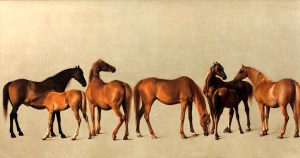
This week, by accident more than by design, I have been led into studying two of the most beautiful paintings I have ever seen – simply breath taking. Even the backgrounds in these two paintings I find to be stunningly beautiful and far from simplistic.

George_Stubbs_Mares_and_Foals_1762

George Stubbs, 1762. Mares and Foals without a Background

whistlejacket-(41860)

George Stubbs, c. 1762. Whistlejacket

I actually feel quite privileged. If I had never embarked upon these MA studies would I have been able to appreciate these paintings as much?

A difficult week, I really haven’t felt like writing. My thoughts have really dwelled on other activities. More than anything I’ve wanted to break away from my desk and use my camera.

I’ve hit a wall, I’ve got whatever the photographer’s equivalent of writer’s block is.

Perhaps it’s a form of “spring fever”.

The Media, Power and Stereotypes

“The tendency to subjugate the mission of gathering evidence to the demands of pictorial appeal becomes especially obvious in the pictures taken by the magazine’s staff and freelance photographers within the last several years. But it is also an inevitable consequence of the Geographic’s modern definition of itself as a magazine of mass appeal.” (Grundberg, 1988).

Grundberg begins his article “A Quintessentially American Point of View of the World” by outlining the role that National Geographic had in informing him at a time when exposure to the world and world events was greatly restricted: fewer publications were available and television was a new technology still in its formative stages.

According to Grundberg, the 1988 exhibition “Odyssey: The Art of Photography at National Geographic” – an exhibition of 200 photographs from the National Geographic archives, was interesting for two reasons: the wealth of images on display and what it said about the way editors and photographers choose to portray the world. This is the limit to Grundberg’s generosity.

He went on to write that the exhibition lacked anything which might give even the merest clue of how the magazine and its photography had developed since its inception.

Rather, it appeared to Grundberg that the purpose of the exhibition was a demonstration of “style” rather than a study of serious photography. I think it is fair to say, from the tone of Grundberg’s writing, that his view on the exhibition reflects his view on the journal itself – overly concerned with style and lacking in any substance.

What would appear to be quite clear is that this sea-change arose when the publication changed from being a “dry scholarly 19th century journal” into a popular magazine intended for consumption by the masses. What is perhaps not so clear is why it might be considered necessary to remove any informative academic content in order for the magazine to appeal to the wide audience targeted by the publishers.

Is it not possible to write articles which present academic material in a way which makes it appeal to a non-academic general public? Or is that the masses are not to be educated or informed? Who decides?

Surely it is feasible to provide a narrative which presents a balanced account of the “world and all that is in it”. However, Grundberg appears to suggest that National Geographic choose, at the time of writing at least, to offer a weak, stylistic portfolio of travel photography seen through the rose-tinted spectacles of a someone akin to a Victorian-era explorer.

National Geographic photography”, focusing on a wide range of subjects including “wildlife, exploration, foreign cultures, scenic vistas and so on”, is observed as having a wide and lasting influence on the way that Americans perceive the world. Grundberg states that National Geographic “currently has a circulation of 10 million copies a month”, America alone had a population of 244 million in 1988 when the article was published, setting aside the fact of a worldwide circulation, how great an influence National Geographic has had on shaping the “American view of the world”, its people and places at any one time is arguable.

Notwithstanding the latter point, why would a publication, any publication, seek to influence perceptions as a result of the way it presents information? Why, for example, would National Geographic choose to “sanitise” what it shows to its readers?

Why would National Geographic choose to portray subjects in “ethnographic pastoral” mode which, as Grundberg informs us, results in “much of the writing found on the magazine’s pages” having a tendency “to verge on the rhapsodic, depicting foreign lands and cultures as exotic and alluring”?

Why not portray the reality of life for the people, and in the places, that are the journal’s subjects?

Foucaldian power discourse focuses on power relationships which exist in society, it is a form of discourse analysis which extends to include semiotic critical analysis.

Looking beyond Grundberg’s evaluation of the “Odyssey” exhibition specifically and National Geographic generally, it would certainly appear that the media works to a definite agenda in order to achieve its aims. It is in a position of immense power – and it makes use of that power.

People are not only told what to think but also, as is the case with much media coverage, what to think of in terms of the subjects that are presented by the media.

With power comes responsibility. It is inevitable that news stories will have a hierarchy, some events taking place in the world will always have a high level of importance whilst others, arguably, are not news at all. But what drives the decision-making process which determines what news stories become headlines, what imagery and copy is used in adverts? And again, who makes the decision?

As tentative as the link might be, is this a symptom of politically correct thinking?

Stereotypes can be insulting at best, and offensive at worst. The use of stereotypical images, even “gendered” images, by the media to force home a point would seem at odds with political correctness. But nevertheless, we should ask the question whether or not the media operates, to some extent, to an ideology of political correctness, even if only to dismiss that question.

Are we really being increasingly told what to think by the way in which the media chooses to present some images and not others? Is there a commonly held perception in the media that the “masses” cannot think for themselves and so should be spoon-fed news and adverts?

Karl Marx is frequently paraphrased as stating that “religion is the opiate of the masses”. Perhaps media, especially “social media”, is the new religion? And perhaps selective and manipulative use of imagery by the media is the “opiate” that induces us to sleepwalk through a subliminally suggestive landscape? The “hypodermic needle” effect cited in reception theory certainly suggests that audiences passively view adverts and unquestioningly accept the preferred message.

Without doubt, photography can help establish or perpetuate stereotypes depending on the agenda the photographer or user of the image is working to.

However, the relationship between the author and the audience is not one-sided as models of passive audience viewing might suggest.

Audience theory suggests that “dominant readings” arise when audiences readily accept the “preferred” message.

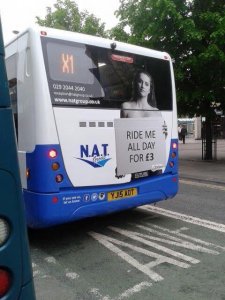
Audiences do, however, question what is presented to it by the media, and, again, audience theory informs us that this is an “oppositional reading”. In Barthes terminology, the “source of emission” is held to account by the “point of reception”, a notable example is the case of the “You Can Ride Me All Day for £3.00” adverts being removed from Cardiff buses within hours of the advertising campaign being launched. This is an example of not only how the media manipulates through the use of stereotypes but also how audiences can question and successfully challenge institutions. Seemingly, though, such stereotypes are commonplace.

ride-me

Ride Me All day for £3” (New Adventure Travel, 2015)

Advertisements make use of “gendered” images, and the use of the “male gaze” with its active, quite often “aggressive”, masculine, and its passive, nurturing feminine roles, is prevalent.

wonderbra

I can’t cook. Who cares?” (Wonderbra, 1999)

By way of example, television adverts for cleaning products do feature male characters, but ask how often that is the case. Advertisements for cleaning products are predominantly aimed at female members of the household.

At a time when gender seems more mutable than ever before, in real terms, gender roles seem just as immutable in the advertising world as ever.

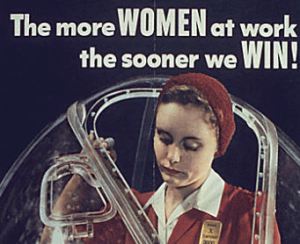
Whilst negative stereotypes might seem to be commonplace in advertising, positive stereotyping can be seen.

women-work

The More Women at Work” Campaign Poster (U. S. Office of War Information, 1943)

So, how can I apply all this to my photographic practice?

For me, the value of this discourse is in appreciating how to engage with audiences, the judicious use of images to ensure appropriateness, and in maintaining integrity. I think there is much more mileage, much more credibility, in an approach which promotes how to think, rather than preaching what to think.

There is no such thing as a single, homogenous audience. Audiences will always demonstrate a spectrum of perceptions, viewing the same thing will elicit a range of different responses ranging from acceptance to opposition. Perhaps the most important message is that people are less prepared to accept if they feel patronised or manipulated, put another way, people are more willing to accept ideas, even opposing views, if they feel they are being spoken to and involved in resolving an outcome, rather than spoken down to as non-participant.


Barthes, R. and Heath, S. (1977) Rhetoric of the Image in Image Music Text. London: Fontana

Grundberg, A. (1988) Photography View: A Quintessentially American View of the World. The New York Times [Online]. Available at: http://www.nytimes.com/1988/09/18/arts/photography-view-a-quintessentially-american-view-of-the-world.html?pagewanted=2 (Accessed: 03 March 2017)

Recycling, Repurposing and Re-framing

All media, newspapers, magazines, etc. could once have been described as “social media” in the sense that they were intended for consumption by a non-restricted audience with, in many cases, increased consumption equalling increased profits. Whilst such forms of media continue to exist and perform their function, the extent to which they do so has diminished greatly. Today, “social media” refers to computer-mediated technologies which facilitate the creating and sharing of information and ideas. This is differentiated from more traditional forms of media in that it is media-sharing with a social element – the people sharing the media are generally its authors and feel that they belong to one of various forms of networks or “communities”.

Barthes referred to the contexts in which images can be consumed as “channels of transmission” in a tripartite system where the authors of images he describes as the “source of emission” and viewers become the “point of reception” (Barthes, 1977, p. 15).

Barrett suggests that the “external context” is “the situation in which a photograph is presented or found”, this includes books, galleries, museums, newspapers, magazines, billboards, and classrooms (Barrett, 2005, pp. 106 – 111). Clearly for Barrett’s external context “situation” to exist in which images can be consumed, both Barthes “channel of transmission” and “point of reception” need to be present (it is given, therefore, that a “source of emission” has authored the image).

Barrett goes on to identify two other contexts: the internal, and the original contexts.

The “internal context” is appreciated by paying attention to the subject of photograph, the medium and form of the image, and the relationship between the three. The “original context” cannot be determined by an examination of the photograph itself as it is dependent upon a knowledge of art and the art world (ibid.).

Meaning is context base, as Price and Wells inform us “One determinant of the way in which we understand photographs, then, is the context within which we view them, and key institutions shape the nature of photography by the way they provide context” (Price and Wells, 2015, p. 61).

Media organisations exist to generate revenue (even not-for-profit organisations) and the sale of images or advertising space play a significant part in establishing that income. Organisations provide a specific context, a platform through which users can engage with the organisation and, in the case of social media, other users. Ultimately though, how the context is used, or able to be used, by users is determined by the culture of the organisation providing the context. For example, whilst there is a clear need for Facebook to safeguard against the dissemination of inappropriate images of minors, most people are familiar with the officious way in which Facebook quickly removes post-operative mastectomy images or images of breastfeeding mothers.

What, then, of the relationship between individuals and contexts?

Contemporary social media owes much of its popularity to its interactive nature where the community members are authors and contributors as much as they viewers and consumers. Images contributed to social media help individuals to define their online identity, where they “shape” the way in which others see them, where they portray themselves as they wish to be perceived, their “ideal”.

“A rapidly expanding system of networks, collectively known as the Internet, links millions of people in new spaces that are changing the way we think, the nature of our sexuality, the form of our communities, or very identities” (Truckle, 1995 p. 9).

In this virtual world of social media, image content is more important than any aesthetic quality, where images are distributed as a symbol of pseudo-status relating to the preferred ideal identity, where they act as a time-stamp confirming the author’s conspicuous-consumption as they “check in” to various social events, make us aware of those in their social circle (and those not), and share with us meals they are preparing to eat. These are the “casual” photographs referred to by Manovich (2016).

Additionally, social media provides individuals with a sense of being connected and belonging that is absent with other forms of media whilst organisations are able to take advantage of the larger audience which, in advertising terms, is accessible at a much-reduced cost.

Social media is a dialogic form of transmission, meaning that there are many sources of information and many users, or to put this in terms Barthes would recognise, there are both many sources of emission and many points of reception. This is opposed traditional forms of media which are monologic where the sources of emission are typically a very small number of powerful organisations delivering information to a wide audience.

Whilst social media offers an immediacy of dissemination, together with affording contributors a sense of belonging and an opportunity and means of assembling an online identity, there are negative aspects to this media form.

Images are, for example, subject to misappropriation, plagiarism and manipulation. Threats to which images placed into online galleries are equally prone if adequate safeguards are not put into place.

Additionally, citizen journalism is a double-edged sword, capable of both informing an audience but also provide an uninformed, unbalanced and biased view of events.

So, what of more traditional media forms?

Newspapers continue to play an important part in keeping us informed of world events because, quite simply, press photographers and journalists have a “journalistic privilege” which affords them access to contacts, news and locations which are beyond the reach of those outside the profession.

Magazines allow viewers to look at images in a way which is very much context based given that “feature” images in magazines work in one of two ways: either being supported by, or supporting text in an article.

Photobooks enable an audience to view, generally theme-based, images in a linear way. Unaccompanied by text, the clue being in the name, images are curated in order to provide their own narrative which takes the “reader” on a journey.

Advertisements on billboards provide a means for organisations to achieve purpose-specific mass-exposure and constitute part of the “out of home” marketing mix. This form of advertising makes use of “downtime” when consumers are engaged in other activities, for example, driving or waiting at train stations and consequently makes use of vivid colours, logos, simple copy and symbols in order to engage the audience and quickly, and effectively, implant the message in the viewer’s mind. The symbiotic relationship between newspapers and magazines who sell advertising space to advertisers, provides the same works on similar principles.

Almost irrespective of context, images can readily be assigned to new purposes, in other words, they are open to be being used in a context different to that originally intended. Sontag (1977, p.174) refers to “new meanings” which can be attached to images either purposefully or incidentally as a result of this “recycling”.

Price and Wells indicate that in such cases of “repurposing”, the original intent for the image can be forgotten “with the passage of time the original motive for the making of a photograph may disappear, leaving it accessible to being ‘re-framed’ within new contexts” (Price and Wells, 2015, p. 70).

It is widely cited that there is no such thing as bad publicity. That may or may not be the case. Whilst Protein World received some negative press for their “Beach Body Ready” ready advert, they no doubt also saw enormous benefit from the pursuant media coverage surrounding the advertisement’s negative connotations. For me, the real winner is the spoof SimplyBe campaign whose adverts cleverly rode on the back of, and benefitted from, the momentum of the “Beach Body Ready” campaign. Here advertisers saw an opportunity to make use of copy, a colour scheme and a subject which were already established in the mind of the audience. Additionally, they built on the consternation of public opinion, portraying themselves as the “good cop” to Protein World’s “bad cop”.

negotiated-2

Beach Body Ready” (Protein World, 2015)

protein-response

Spoof Protest Advert (SimplyBe, 2015)

In terms of my commercial photographic practice, images are supplied to clients for use on business websites, in menus or for display in dining areas and these currently constitute the “point of reception” for my practice. Work is underway to develop other platforms for the consumption of my work including publication in books and magazines where my images will support text-based recipes.

The “channel of transmission” for this area of my practice will be a website in conjunction with appropriate forms of advertising literature (flyers, leaflets, and business cards).

In relation to my project, it is my intention to establish a dedicated online gallery. This mode of dissemination makes the project available to the widest possible audience, and range of audiences, whilst incurring least costs and is, therefore, the optimum context notwithstanding image safeguarding issues.

Looking beyond the project deadline, I intend to continue to work on the project, increasing the range of contexts through which audiences can view my work: the feasibility of an exhibition and a photobook are two options currently being explored.

Newspapers and magazines, especially local press in the early stages, will be appropriate contexts, or “channels of transmission” through which to make audiences aware of my project and any exhibitions, online or otherwise.


References

Barrett, T. (2005) Criticizing Photographs: An Introduction to Understanding Images. New York: McGraw-Hill pp. 106 – 111

Barthes, R. and Heath, S. (1977) Rhetoric of the Image in Image Music Text. London: Fontana

Price, D. and Wells, L. (2015) ‘Thinking about Photography’, in WELLS (ed.) Photography – A Critical Introduction. Oxon: Routledge

Manovich, L. (2016). Subjects and Styles in Instagram Photography. Manovich.net [Online]. http://manovich.net/content/04-projects/090-subjects-and-styles-in-instagram-photography-part-1/lm_instagram_article_part_1_final.pdf (Accessed: 28 February 2017)

Sontag, S. (1977) On Photography. New York: Farrar, Straus and Giroux

Truckle, Sherry. (1995) Life on the Screen: Identity in the Age of the Internet. New York: Simon and Schuster Paperbacks
On Reflection: Week 5, Module Two

Work expands so as to fill the time available for its completion” – C. Northcote Parkinson

Bit fraught this week (to say the least) … …

Being half a week behind schedule took some recovery and I’m still seeing, and feeling, the effects now.

Anything that can go wrong, will go wrong (eventually)” – Murphy’s Law

Sod’s law states that when (note when, not if) something does go wrong, it is always with the worst possible outcome – and that sums up my week!

… …

The “male gaze” – previously, this is something I have been unaware of, perhaps naively. Interesting theory, and enlightening.

Now I am aware of the “male gaze” and having searched the term “advertisements gaze” I was surprised to see just how many advertisements are sexualised and chauvinistic. This can, of course, be balanced by the “female gaze” theory. (This is huge area to explore). Nevertheless, eye-opening to see how ideologies can be manipulated.

… …

What “spare” time I have had this week, quite a lot of it has been spent contemplating what it is that makes an image appealing, using the work of Vermeer as a reference.

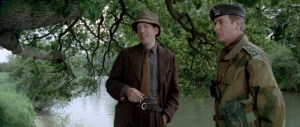
devlin

Holy Trinity” … …

It’s all right, Father, I’m just telling him about the Holy Trinity. You know it? Footwork, timing, and hitting!” – Liam Devlin, The Eagle Has Landed

(Touch of intertextuality there … keep it fresh in the mind, Philip, keep it fresh in the mind).

OK, so not that Holy Trinity.

It’s obviously a very complex issue which brings forth some highly subjective answers.

But what I have determined is that there are some common traits shared by, at least some, great images. These are:

A sense of familiarity

A sense of timelessness

A sense of ambiguity.

I won’t expand on these here, it’s not really the forum for one reason. Another reason is that I plan to write a small article based upon my research in this specific area.

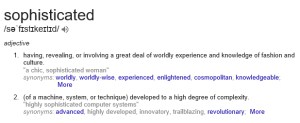
Sophistication” is a buzzword at the moment. Think it will be for the foreseeable. It’s so easy to assume we know the true, dictionary definition of words. Not wishing to fall into a trap of my own making (seem to do that often enough anyway), I thought I would check the definition of its root, sophisticated, and fix it in my mind:

sophisticated

Something to reflect upon as I look, over the forthcoming week, to the development of my project and the next round of assignments which are gathering like a black cloud on the horizon.

The Gendered “Gaze”

“Of Mother Nature and Marlboro Men …”

Genderization in the media

carlsjr-e13269880326791

Carl Jr Advertising Campaign, 2005

The “male gaze”, a term first referred to by Laura Mulvey, is the way in which women and the world are depicted from a masculine point of view, by the visual arts, as objects for male pleasure.

Feminist film critic Mulvey introduced the term in her 1975 essay “Visual Pleasure and Narrative Cinema”. In her essay, Mulvey posits that gender power asymmetry is a controlling force in cinema and constructed for the pleasure of the male viewer, which, in turn, has its basis in patriarchal ideologies and discourses.

Consisting of three component perspectives, the person behind the camera, the characters within the text, and the spectator, the “male gaze” occurs when the audience is placed into the perspective of a heterosexual male by the camera. Females are typically (or stereo-typically) displayed on two different levels: as an object of erotic desire for the characters in the text, and as an object of desire for the “spectator”.

The male is portrayed as a dominant power, whilst the female is shown as being passive and subordinate.


Mulvey, Linda. (1975). ‘Visual Pleasure and Narrative Cinema”. Luxonline.org.uk [Online]. Available at: http://www.luxonline.org.uk/articles/visual_pleasure_and_narrative_cinema(printversion).html (Accessed: 26 February 2017)


Voyeurism … or not?

bacchus

Morris, 2017. Bacchus

The “gaze” is a tool of exploration, a means by which we can analyse the relationship between the image maker or viewer, and the subject.

Any commercial work that I undertake has to fulfil different criteria to that of my project work.

In terms of my project, my intention is to produce images with an aesthetic appeal in their own right. My commercial work is based on an intention to inform and promote.

To observe the visual characteristics of my subjects I have to be detached, and view from a distance. This is the “spectator’s gaze” and involves exclusively the sense of sight. To fully understand the physical characteristics of the subject itself, I have to “become one with it”. This leads to an almost direct address or “extra-diegetic” point-of-view and involves the senses of taste, smell, touch and sound.

Both kinds of knowledge are required to accurately portray the true “character” of the subject.

However, whichever hat I happen to be wearing, for images to be successful, I have to be an observer – this is a constant.

What changes, though, is the viewpoint and the distance from which I observe.

Angier (2007, p. 61) points to distance being a basic condition of a voyeuristic relationship between the “seer” and the “seen”. Pertinently he points out that whilst the popular conception is that there has to be a sexual element in order for voyeurism to be established, this is not actually the case. Moreover, what is needed in addition to the basic condition of distance, is an element of desire for the subject on the part of the viewer, that is to say, the “seen” must be wanted by the “seer” in one form or another.

Angier suggests that, in addition to the viewer “wanting” the subject, there must also be elements of both “unavailablity” of the subject and ultimate “non-desire” on the part of the viewer.

However, are the two latter “pre-requisites” really pre-requisites after all? Is it not the case that we have all viewed something in a voyeuristic manner when the subject has been available, and we have ultimately wanted it?

So then, is my “gaze” voyeuristic? Quite possibly.

With its root in the French verb voir – to see, are we not all voyeurs anyway? Especially given that Angier suggests that a sexual element does not need to present?

If the latter points hold true, is my “gaze” now voyeuristic? I think almost definitely.

Angier, Roswell. (2007) Train Your Gaze: A Practical and Theoretical Guide to Portrait Photography. Switzerland: AVA Publishing SA