‘Art has to move you and design does not, unless it’s a good design for a bus’
– David Hockney
‘Art has to move you and design does not, unless it’s a good design for a bus’
– David Hockney
‘Your photography is a record of your living, for anyone who really sees. You may see and be affected by other people’s ways, you may even use them to find your own, but you will have eventually to free yourself of them. That is what Nietzsche meant when he said, “I have just read Schopenhauer, now I have to get rid of him.” He knew how insidious other people’s ways could be, particularly those which have the forcefulness of profound experience, if you let them get between you and your vision.’
– Paul Strand, in Sontag On Photography, p. 183
My position at the start of module four …
The title of my project is The Photographic Art of Food.
Contemporary food photography, in my view, is overly concerned with the promotion of commodities. Its singular goal has become to make someone eat or drink whatever the subject of the photograph may be. Arguably, it is the art of persuasion.
Food photographer and historian Helen Grace Ventura Thompson identifies with this, stating: ‘images are no longer works of art, but promoters of consumer goods’.
I think contemporary food photography results in a very formulaic output, and in an audience expecting a certain type of image.
Consequently, I believe the principle which underpins my photography is this: images of food can be art – existing as objects which entertain and are visually appealing whilst fulfilling a practical purpose.
Putting this another way, portraying the ordinary in an extraordinary way is a principle which underpins my photographic practice.
Beauty should not be the price for documenting, recording and educating.
That even the banal can be beautiful is a view held in common with the Czech photographer Josef Sudek, whose work has also been a significant influence.
Summarising the work of modules 1 to 3, module one saw me begin to explore the following:
The knowledge, technology and methods employed by the old Dutch masters to control light, and how the atmosphere and aesthetics of food images are influenced by light and various lighting styles
The knowledge of the elements of design that was available to the masters
Rationalising the symbolism used by the masters, evaluating their reasons for its use as well as the sources of their information.
Module two saw this exploration continue but with two project themes: Ten (recording the meals consumed by ten school children on the same March evening) and Junk Food, it began to take on an aspect of visual anthropology
Module three saw a strong focus on the visual narrative – examining the process of story-telling.
Unfortunately, a house move, injury, illness and a period without internet provision delayed my submission of the assignments for module three. My intention, then was to catch up: completing and submitting the assignments before the commencement of module four. This objective has been achieved.
Cravings is a series of images, produced as a portfolio submission for module three, which depict the choices facing a particular individual, and the compromises which need to be made if specific goals are to be reached.
The intention is for these images to document the struggle for an athlete in preparation for competition to maintain a strict ‘clean’ diet, and the resultant desire to consume ‘comfort’ foods as the body depletes stores of fat to fuel the training.
The subjects are items craved by the athlete, and consumed as a weekly treat, or as part of a ‘cheat’ meal.
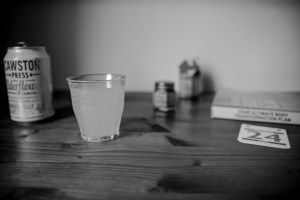
Morris, 2017. Untitled # 9
‘We have art in order not to die of the truth ‘
– Friedrich Nietzsche
Video presentation assignment for module three, Surfaces and Strategies.
The video discusses the motivations for my photography, in addition to outlining methods and strategies for image-making and image-sharing.
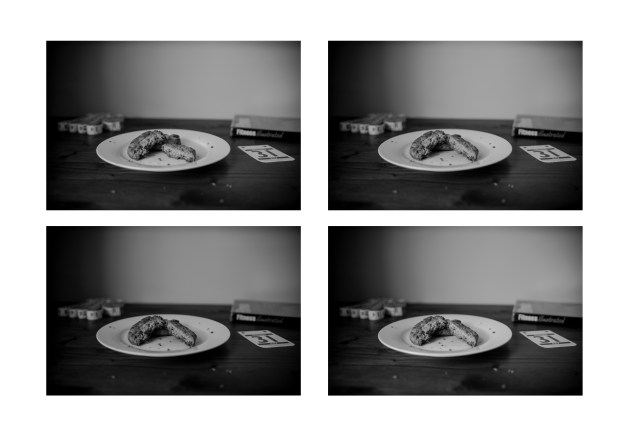 Variations of composition (Morris, 2017)
A series of four images seemingly without discernible difference.
This is, however, not the case. The images, produced during shooting for my latest project Cravings, differ subtly.
The first image in the sequence (top left) feels out of balance to me.
Second in sequence (top right) is taken after a small adjustment – the result of some evaluation and ‘what happens if?’ But still the image doesn’t ‘feel’ right – there is still a feeling of imbalance.
Next in sequence, image three (bottom left), shows a further subtle adjustment, carrying on from the adjustment seen in image two. The overall effect is an improvement, but it’s not quite right yet.
Image four (bottom right), extends the change a little further.
To me, this image has the balance that was missing in images one to three.
It is images one to three which have a feel of disquiet about them, something is amiss – things are not in order. Despite only requiring a small, subtle change, these three images don’t feel comfortable. Something feels unnatural – it shows that we seek order in chaos.
Even when things are in a state of disruption, perhaps even decay, there is still an order that we are able to recognise – even in a state of flux we look for patterns, searching out and recognising the familiar.
I feel that this relates strongly to a principle underpinning the work of Czech photographer Josef Sudek, a principle which also guides my photographic practice – that there is beauty even in the banal: the ordinary portrayed in an extraordinary way.
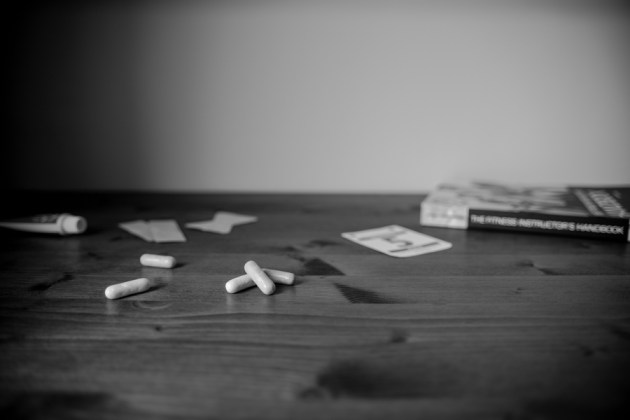
Morris, 2017. Untitled # 6
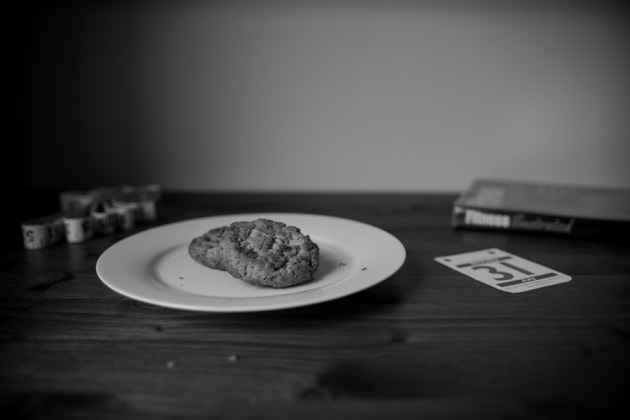
Morris, 2017. Untitled # 7
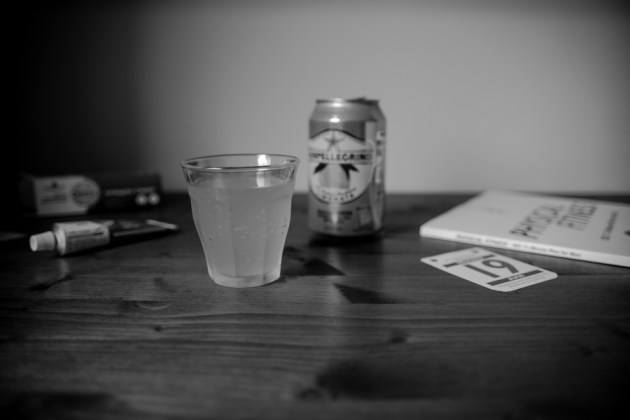
Morris, 2017. Untitled # 8
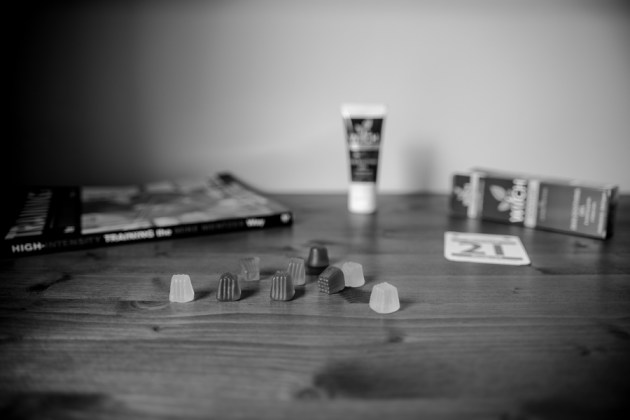
Morris, 2017. Untitled # 9
As the Cravings project develops it is clear how well these images are held together by the overarching theme – that of the struggle and pursuant compromises for an athlete to maintain a strict ‘clean’ diet during preparation for a competition.
Nevertheless, individually, these are strong images – technically and artistically.
Presented in monochrome, bringing a timelessness and focusing the viewer’s gaze on content and meaning, the series is a significant departure from the way in which contemporary food images are typically presented and is, therefore, quite unique.
There is a quality of richness that results from the monochrome post-processing of the images. The chiaroscuro as a design element in each image being augmented by this treatment – another mechanism by which the viewer’s gaze is led through the image. The drama brought to the images by the strongly contrasting areas of black and white is reminiscent of the mystery associated with tenebrism.
A very shallow depth of field is exploited, producing a bokeh which adds further richness to the images. This is an aesthetic which appeals to me very strongly. It is also a boundary I want to push – the Cravings series being shot at f2/8. In future projects, I want to push the aperture wider – looking at f1/4 to f1/2.
What are we actually saying when we operate a camera shutter? What statement are we making?
The very act of framing a picture places a photographer in a position of power.
What is included? What is not? Why? And how?
How many people contemplate photography?
Most people, I suspect, regard operating a camera, pressing the shutter, as a simple process. And it is, on a purely mechanical level.
There is always a motive, from fulfilling the needs of a news desk, to filling a family photo album. There is always a reason.
I think the implications of taking photographs escape most people, by that I mean that a significant number of images are generated without any prior consideration. Little, if any, thought is given as to why the image is being taken, or to the value of the image.
But at what cost are images made?
Are the images obtained ethically? Has appropriate consent been obtained? Have trespass laws been broken? Do the images show classified information? Have models been exploited?
Do the same rules apply to professional and non-professional photographers?
I think the same rules do apply, but are not perceived to apply.
Arguably, even the best photographers are only as good as their reputation – controversy is not normally a strong selling point (although of course there are exceptions to this).
But for non-professional photographers, the rules seem to apply only to other people, with photographs being taken in inappropriate places, or inappropriate ways.
MA Photography student Jo Sutherst recently visited Auschwitz. The following is an extract from her subsequent journal entry:
‘Left almost untouched (except for the planting of trees and green areas) since the Nazi forces left the site in January 1945, the site is now a museum of global importance.
Each block that you visit on the site has a specific part to tell about the story of the events that took place there. The rooms where the victims’ belongings were displayed were the hardest to visit. The photographs on the walls appear almost banal. They do not show the true horror that happened. The subjects stare at the camera, or look elsewhere; no violence or death is depicted.
Looking at the suitcases, shoes and human hair left us without words. But not everyone on the tour reacted that way. Many were happily photographing every aspect they could, taking selfies to show that they had been there. Philip and I discussed later how disrespectful and shocking to us this act was.
The human hair preserved in a darkened room was used by the Nazis to produce socks and carpets. It is strictly forbidden to take pictures in this room, as it should be out of respect for the victims. It is a sad sign of our times, that this even has to be specified on large signs at the entrance. Yet, there are people who sneakily take shots in this room. I do not understand how anyone would think it was appropriate to take images in such a place.
This prompted a long discussion between myself and Philip later in the day about Auschwitz and photography’ (Sutherst, 2017).
There are ethical and moralistic obligations attached to the way we take images, and to the way those images are ultimately used.

It’s Media (Author and date unknown)
The cartoon It’s Media illustrates how images can be used to fulfil an ulterior motive.
The cartoon shows how a situation has been manipulated to produce a fictional reality, in this case by taking an abstract and removing the context.
It also makes reference to the fact that our views can and are changed. Sometimes the change is informed, but not always. Sometimes, we seek to change our views proactively (self-improvement, for example), on other occasions the change is made for us – for example, as a result of the way media reports news, or by skilful marketing which uses psychology as a basis.
What is the relevance of this to my photographic practice? Ultimately, I am concerned that my images present a true and fair view. I want to be regarded as a good photographer, both technically and artistically (whilst bearing in mind that my work will never appeal to everyone).
The question I pose myself is this, is it possible to produce images which have a narrative, whilst also being unbiased and objective? For me, this largely comes down to two things: research – knowing the subject, and personal integrity.
This brings me back to my two original questions: what are we actually saying when we operate a camera shutter? What statement are we making?
I believe that when we photograph, we are making a statement about ourselves, and our motives, and our beliefs, and our culture.
How our images are used can be beyond our control, perhaps now more than ever, certainly digital images placed online are open to misappropriation. That can lead to inappropriate use as our images are used in a context different to that originally intended.
But as photographers we have an obligation to ensure that what we present has some objectivity, unless of course we are intentionally creating escapist art, i.e. fantasy or science fiction art. If we are not in complete control of how our images are used, we can control the integrity of ourselves and our subjects.
As seems to be the case at the moment, this tends to generate more questions, than it does answers.
What am I trying to represent? And why? Who is interested? Is anybody interested? Is there a point at which a psychological divorce takes place between a viewer and an image, in terms of visual appeal, if that image is obtained unethically?
We live in a world where, perhaps more increasingly, we need to ask ‘why is this person telling me this? But shouldn’t we be asking ourselves this question on a regular basis anyway? Because the alternative is that we blindly accept everything we see and hear? And at the very best, that leads to stagnation and, arguably, at worst to prejudice.
References:
Sutherst, Jo (2017) ‘Auschwitz and Photography’, Josutherstphotography.blog [online]. https://josutherstphotography.blog/2017/07/14/surfaces-and-strategies-auschwitz-and-photography/ (Accessed: Tuesday 05 September 2017)
‘No great artist ever sees things as they really are. If he did, he would cease to be an artist’
– Oscar Wilde
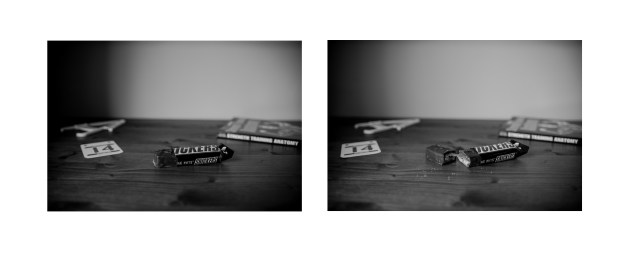 Variations of Composition (Morris, 2017)
Working on the images for the module three Work in Progress portfolio realised an opportunity to explore composition.
More specifically, it was an opportunity to explore subtle variations in composition.
It was a valuable exercise in perceptions.
Furthermore, it enabled me to gather material for a future workshop which is planned.
Playing around with various compositional arrangements took me down quite a philosophical path.
Perceptions operate via various routes simultaneously.
Take, for example, a simple bar of chocolate. In photographic terms, the chocolate itself is irrelevant. Instead, the two factors which are important are the outer wrapping, and the combination of ingredients.
It seems superficial, but from a food photography point of view it is highly relevant. Without a wrapper, and assuming integrity (i.e. the surface of the bar has not been broken in any way to reveal the inner contents), what is there to differentiate between, say, a Snickers bar, a Mars, and a Milky Way?
Consequently, I found myself asking this week, what exactly is it that I am photographing? What is a Snickers bar for example?
Where does the product itself begin, and the packaging end?
Is a Snickers bar the combination of ingredients? Or, is it the combination of ingredients within a unique and specifically designed wrapping?
Francis Hodgson suggests that photographs are of something, and about something, with the latter point often being overlooked. Barthes and Heath suggest that images represent the signifier and the signified.
In these terms, a Snickers bar and its wrapper are the ‘of something’, the signifier. What they imply, the signified – the ‘about something’, can (in my opinion) be one or more of several things.
Firstly, it implies that we ‘beautify’ the food we eat: we need the wrapper to do this – to make the chocolate appear more appetising than it otherwise might be.
Chocolate isn’t eaten for its visual appeal (unless it’s a Black Forest gateaux), it is eaten for its addictive sweetness and the endorphin rush its metabolism causes. Taken purely on face value, does an unwrapped bar of chocolate really look appetising? Does it really initiate a gustatory reflex?
Secondly, it makes a statement about how we live our lives. Busy lives require food in portions that make the task of eating on the go an easily managed task. Discrete little packages of food to be eaten on the go, to be consumed conveniently need wrappers.
Thirdly, it is part of a sanitising process, helping to keep food fresh and clean.
Finally, it reflects the homeostatic (need to eat) and hedonic (eating for pleasure) aspects of appetite.
So much for our Snickers. But we can extend this – steak doesn’t come pre-cooked, it doesn’t come in a form that we accept as being edible. We grill it to make it more digestible (the proteins are broken down by the cooking process, and the cooking process has a sanitising effect). Steak in its natural state isn’t appealing – again, the cooked appearance of a nicely grilled steak is the signifier, the treatment of our food the signified.
Frith writes that: ‘Advertising only “makes sense” when it resonates with certain deeply held belief systems’ (Frith, 1997: vii).
I think that with this seemingly simple statement, Frith is telling us none of this hangs together unless we all buy into it – literally.
All this brings me back to my earlier question: what exactly is it that I am photographing? The product? Or it’s wrapper?
And that is why clever advertising people invented something called the ‘brand’.
References:
Barthes, R. and Heath, S. (1977) Rhetoric of the Image in Image Music Text. London: Fontana
Francis Hodgson: Quality Matters (2013) YouTube Video, added by Huis Marseille, Museum for Photography [Online]. https://www.youtube.com/watch?v=3dj3Wq-I7tc accessed 19 February 2017
Frith, Kathleen Toland. (1997) Undressing the Ad: Reading Culture in Advertising. New York: Peter Lang
 The Photographic Art of Food - An MA Photography Project