Thinspiration: Laia Abril

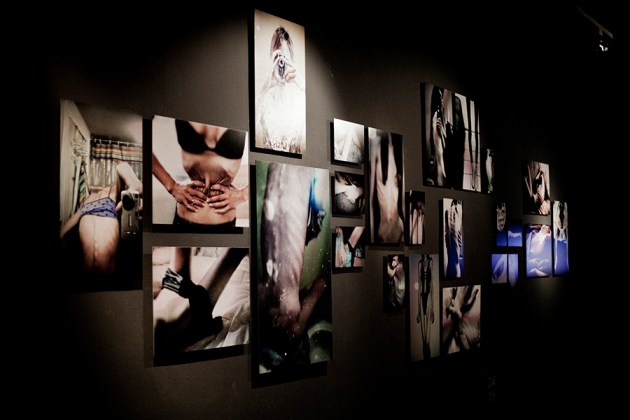
‘The Pro-ana community has turned anorexia (Ana) into its dogma. They venerate the illness giving meaning to their totalitarian “lifestyle”. It’s a virtual reality where they state commandments, share motivating tricks and exchange hundreds of images of thin models via their blogs. They have created Thinspiration, a visual new language – obsessively consumed to keep on wrestling with the scales day after day. Now, they evolved interacting with their cameras portraying their bony clavicles or flat bellies; or consuming extreme anorexic images, the Pro-ana have made Thinspiration evolve. I re-take their self-portraits, photographing and reinterpreting their images from the screen, resulting the visual response to the bond between obsession and self-destruction; the disappearance of one’s own identity. The project is a personal and introspective journey across the nature of obsessive desire and the limits of auto-destruction, denouncing disease’s new risk factors: social networks and photography.’

Thinspiration, Laia Abril (2012)

Abril 4

Abril, 2012. Thinspiration – exhibition
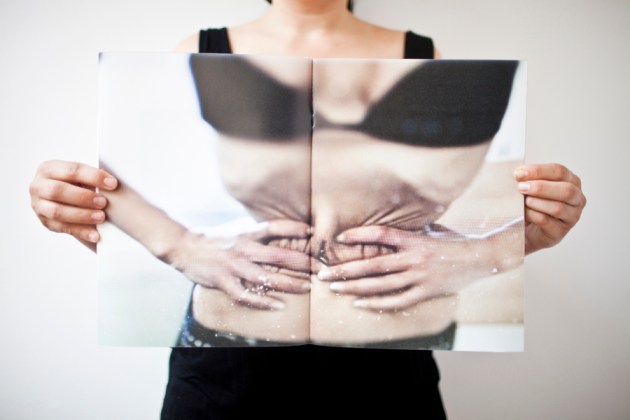
Abril 3

Abril, 2012. Thinspiration – book detail

In her own words, Laia Abril’s photography examines the ‘most uncomfortable, hidden, stigmatized, and misunderstood stories’.

Interviewed by Anna Mola for Private Photo Review, Abril’s motivations for exploring eating disorders through the medium of photography are very clear.

The intention behind Thinspiration, Abril informs us, was to challenge the widely held misconception that all eating disorders are about a girl who won’t eat.

Abril favours working with subjects which are close to her personal experience. Subjects which, because of this closeness, she finds are easier to connect with and subsequently translate for an audience. Indeed, Abril has first-hand experience of one particular eating disorder, having suffered from bulimia for ten years before completing a year of treatment in 2010.

Seeing herself as an intermediary, Abril describes herself as visiting (mental) places nobody wants to go to, digesting issues and producing work which people can relate to and which evoke empathy.

Abril describes working in an intuitive way in the earlier stages of her career. She goes on to explain that whilst still developing in an organic way, her work is now more informed by her vision for the finished body of work and that experience in knowing what a finished body of work will look in relation to a given platform plays a major part in development.

Producing work which is consumed across a range of platforms simultaneously, Abril informs us that the initial platform for her work sets the mood for the work, and that this is fixed. However, she goes on to tell us that whilst work is produced with one particular platform in mind from inception, she does adapt work in later stages to suit alternative platforms with the essence, or the soul (mood) of the work remaining unchanged.

Generally, Abril’s work is produced initially as a photobook which she suggests offers the audience time to digest the difficult and complex issues which are the subject of her work.

With regard, however, to her multi-platform style of presentation, Abril identifies the complexity of the issues she examines, together with the need to work outside her comfort zone, as being the driving factors.

In terms of relevance to my photographic practice, it would appear that Abril and I share a common aim – that of educating to prevent.

‘Above all, life for a photographer cannot be a matter of indifference’ (Robert Frank).

I believe that as photographers we have a duty to highlight social issues, to raise awareness.

There were several different possible subjects for my Final Major Project and each one was explored for its advantages and disadvantages. Once I decided on exploring anorexia and the pro-Ana culture it seemed it seemed immediately natural to think in terms of publishing the body of work as an online gallery with accompanying audio-visual. It seemed equally natural to think about how the life of the project could be extended by producing a photobook, and further extended by exhibiting in schools and colleges.

It is, therefore, reassuring to receive confirmation that such a multi-platform, multimedia presentation strategy has been used so successfully by Abril.

I have a very clear vision for the way I want the online gallery to look, and this vision was established very early in the project. Other platforms will utilise the same images, adopted appropriately – again this intention was determined at the beginning and is a strategy also employed successfully by Abril.

Previously I have cited Goldin as one of the informers of my practice due to her preference for gritty, longform style documentary photography. It is, therefore, interesting to note that Abril also offers Nan Goldin as an influence upon her work.

Clearly, Abril is a skilled visual storyteller and an accomplished publicist. Working intuitively in the early stages of my career leads me to implement some of the strategies employed so skilfully by Abril.

This leads me, then, to ask the question what would I do differently?


References:

Abril, Laia (2018). ‘A Conversation with Laia Abril’. Conscientious Photography Magazine [online]. Available at: https://cphmag.com/conv-abril/ (accessed 07 March 2018)

Abril, Laia (2012). ‘Laia Abril – Thinspiration’. Private [online]. Available at: https://www.privatephotoreview.com/2012/10/laia-abril-thinspiration/ (accessed 06 March 2018)

Laia Abril (2018). ‘Thinspiration’. Laia Abril [online]. Available at: http://www.laiaabril.com/project/thinspiration/ (accessed 08 February 2018)
Notes on Tutorial: 28 February 2018

Contemporaneous notes of a 1-2-1 tutorial: Dr Wendy McMurdo – Wednesday 28 February 2018, 1100 hrs

The concept for the Final Major Project was introduced: Jo-Ana – the diaries of an anorexic visually described in photographs. WM commented that this was both interesting and topical.

Laia Abril’s†1 Thinspiration was introduced as an initial point of research.

Sarah Davidmann’s†2 Ken. To be Destroyed was also suggested for its value in photographically documenting found artefacts.

The Diary Drawing’s of Bobby Baker†3 document the performance artist’s ‘experiences of day hospitals, acute psychiatric wards, ‘crisis’ teams and a variety of treatments’. Started in 1997, the drawings became a way for the artist to articulate complex emotions and thoughts to family, friends and professionals.

It was suggested that as the premise for the project was the diary entries of an anorexic, the diaries themselves should be at the very heart of the body of work.

WM indicated that an artist’s statement would be required – this could be anything from a paragraph to a page. It was also indicated that a statement would be needed to convey the thoughts of the participant (who could remain anonymous) – again, this could be from a paragraph to a page in length.

The importance of evidencing my research and reflections regarding the ethics of the project was discussed.


Links

†1 Laia Abril: http://www.laiaabril.com/project/thinspiration/

†2 Sarah Davidmann: https://www.saradavidmann.com/

†3 Bobby Baker: https://wellcomecollection.org/exhibitions/bobby-bakers-diary-drawings

Intuition

‘With my photography work I don’t make too many plans, I just have a framework; and then I want my intuition to inspire the work. If you take an overly intellectual approach I feel the work becomes too illustrative and didactic’.

– Ori Gersht (in Read, 2014, p. 53)

Reference

Read, Shirley (2014). Exhibiting Photography: A Practical Guide to Displaying Your Work. Oxon: Focal Press

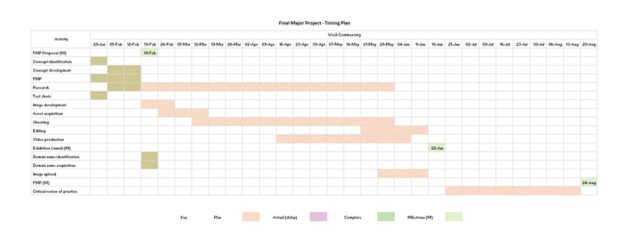
FMP Timing Plan

FMP Timing Plan

Timings for the project are based on a completion date of 22 June, this allows a nine-week period for subsequent critical evaluation and write-up before an assignment submission date of 24 August.

Identification and development of the concept, image design, and asset procurement are the critical factors for the project – those factors upon whose completion all other tasks depend.

Float days are built into the timing plan to allow for contingencies, for example, illness, for reshoots, and to allow for critical evaluation.

FMP Research Strategy

Rose (2010, cited in Mannay 2016) informs us that ‘visual imagery is never innocent; it is always constructed through various practices, technologies and knowledges’.

Mannay (2016) advises:

‘There is a need to adopt a critical approach to reading visual images, one that thinks about the agency of the image, considers the social practices and effects of its viewing, and reflects on the specificity of that viewing by different audiences. As academics we need to question our own readings of images and narratives and in doing so recognise our own ideological commitments and specific ways of knowing.’

Caution, then, is needed in the selection and interpretation of any images used as research data, and in the production of any images resulting from that research, ensuring a true and fair representation of how the groups or individuals being studied perceive their environment – the aim being to evoke an empathic understanding for the alternative ways in which subjects view their world.

Two earlier projects, Cravings and Carousel, have examined alternative relationships with food.

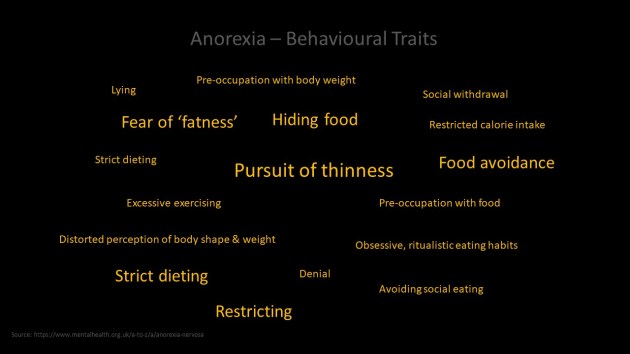
‘Anorexia nervosa is an eating disorder characterised by restrictive eating and an intense fear of gaining weight. While anorexia is often recognised physically through excessive weight loss, it is a serious mental health problem’ (Mentalhealth.org.uk, 2018).

I want to visually describe the innermost thoughts which characterise this disease and by doing so help raise awareness – informing family and friends of the signs and symptoms which the addictive element of the illness compels anorexics to hide.

In essence, Ana as a Final Major Project will be a way for me to extend my knowledge and understanding, and that of others, through photography.

It is, therefore, my intention to produce a series of images illustrating the world is inhabited by those who suffer from anorexia. What are the factors which trigger anorexia, what factors operate to keep them in their world, and what factors operate to free them?

Importantly, how representative are the images which anorexics consume, seemingly with more enthusiasm than they consume food?

How strongly does the pro-Ana culture feature in the reinforcement of the eating disorder?

Items of food consumed by Marie are portrayed: from the standard-sized nutrient rich portions pre-illness to the sparse, nutrient poor items consumed during the days of her illness before the calorie-dense meals of recovery.

Personal possessions depict her interests and suggest the events that happen in her life.

Notes that she writes for herself, together with images she finds inspirational show the transition from good health to illness, and to recovery.

Research will draw upon the following sources:

Diaries written by recovered anorexics

The strong subculture is associated with anorexia and eating disorders in general

Laia Abril’s Thinspiration

Images of superthin models, images of anonymous anorexics, images taken of themselves by anorexics – the ubiquitous ‘selfie’

Online blogs and pro-Ana websites.

These can be identified as ‘found materials’.

‘In considering what can be found, and made the subject of social science inquiry, there are a plethora of existing visual and textual sources including print media, film, everyday cultural artefacts, personal communications, advertisements, internet, heritage sites and art works. Found materials position social scientists as image and narrative collectors, who then apply theoretical lenses to interrogate, examine and understand these objects of inquiry’ (Mannay, 2016).

What is the justification for my use of such sources?

Woolf (2015) informs us that western society has a problem – the glorification of eating disorders.

‘Even if you’re not actively looking for encouragement with an eating disorder, even if you avoid the internet altogether, you can’t avoid the overwhelming message of our age, that weight loss is good, weight gain is bad, that thinner (harder, leaner, greener) is better. We live in a hypervisual age, with most of us – especially the young – confronting thousands of images every day. The focus on women’s bodies is intense, in every magazine, website or TV advert, on every billboard and celebrity shot, and in the conversations of friends, mothers and sisters around us.

The effect can be profound, and yet still eating disorders are misunderstood. They are dismissed as a teenage, female condition (although male eating disorders are on the increase) or misrepresented as faddy dieting, body hang-ups, a phase they’ll “grow out of”. In fact, the opposite is true: eating disorders are highly addictive, and self-starvation becomes involuntary.

Anorexia has the highest mortality rate of all mental illnesses, more deadly than schizophrenia. One in five anorexics will die, either from physical complications or suicide’.

Wilson et al. (2006, cited in Johnson, 2015) inform us that ‘Pro-eating disorder websites host communities of individuals who engage in disordered eating and use the internet to discuss their activities’.

How prevalent is the use of such websites?

Custers et al (2009, ibid.) found that 12.6% (n = 90) of the girls and 5.9% (n = 42) of the boys from a sample group of 711 children and adolescents (7th, 9th, and 11th) grade had visited pro-anorexia websites.

Furthermore, a separate survey showed that 35.5% of 76 patients who had been treated for eating disorders in an outpatient clinic had visited pro-eating disorder sites (Wilson et al., 2006, cited Johnson, 2015).

There is further justification for using found materials as a data source, rather than generating data through subject participation. Anorexia is an addictive mental illness, and many factors act as triggers, perpetuating the illness: an inadvertent question, or a pertinent question asked inappropriately could trigger.

Furthermore, many anorexics hide their illness – compelled to do so by its addictive element, in some cases the illness is hidden from family and friends for years.

Those that do reach out for help become protected by the rules of patient confidentiality. An established track record of handling research with sensitivity, reverence and discretion is needed before clinicians will even consider approaching patients to volunteer for a research programme.


References

Johnson, Hadley A. (2015) I Will Not Eat – A review of the Online Pro-Ana Movement [Online]. New York: Adelphi University. Available at: https://www.semanticscholar.org/paper/I-Will-Not-Eat-A-Review-of-the-Online-Pro-Ana-Move-Johnson/b7a8b83bec0e6df021b83d4696ff8ac49c6819c8 (accessed: 09 February 2018)

Mannay, Dawn (2016), Visual, Narrative and Creative Research Methods: Application, Reflection and Ethics. Oxon: Routledge

Mentalhealth.org.uk (2018). ‘Anorexia nervosa’. Available at: https://www.mentalhealth.org.uk/a-to-z/a/anorexia-nervosa (accessed: 30 January 2018)

WOOLF, Emma (2015). ‘How social media is fuelling the worrying rise in eating disorders’. The Telegraph, 04 June 2015 [online]. Available at: http://www.telegraph.co.uk/women/womens-health/11649411/How-social-media-is-fuelling-the-worrying-rise-in-eating-disorders.html (accessed: 30 January 2018)