Yousuf Karsh, Master Photographer

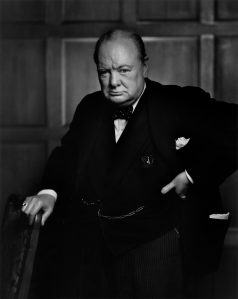
Yousuf-Karsh-Winston-Churchill-1941-1557x1960

Karsh, 1941. Winston Churchill

‘One of the great portrait photographers of the 20th century, his subjects were as great as his mastery of technique’ (Time.com, 2015).

The Library and Archives Canada is home to the Karsh collection. The 355,000-item collection includes all the transparencies, prints and negatives that were produced by Karsh from 1933 until acquisition by the Library and Archives in 1987. Negatives alone account for 150,000 items of the inventory.

Yousuf Karsh opened his first studio in 1932. By the time of his retirement in 1992, he had photographed more than 15,000 world leaders, artists and scientists. Over 20 of his images had featured as cover photographs for Life magazine.

As I write, Karsh’s iconic 1941 image of Churchill features on the £5.00 note currently in circulation in the United Kingdom (November 2017).

What, then, of the characteristics which not only define, but set his work apart?

Jerry Fielder worked as Karsh’s photographic assistant between 1979 and 1992, he is now director and curator of Karsh’s estate. Interviewed by Eliza Berman in 2015, Fielder described Karsh’s technique accordingly: ‘you can teach technique, but talent is innate, and he just had a great understanding of light’. In Berman’s words, Karsh considered light to be a tool, and he manipulated it expertly both in the studio and the darkroom.

The lighting in Karsh’s portraits is described as dramatic. Karsh acquired his knowledge under the tutelage of portrait photographer John Garo.

Garo is rarely referred to today. However, he was a well-known member of the photographic community in Boston in the 1930s, and it was to Garo whom Karsh was apprenticed.

It seems very reasonable that Karsh was influenced by the light falling into Garo’s skylight lit studio.

The Ottawa Little Theatre displays several of Karsh’s original photographs. It was also here that Karsh, who was a member of the theatre, learnt about the theatrical lighting which was to become his trademark.

Setting technique aside, Karsh had enormous empathy with his photographic subjects. In his own words: ‘there is a brief moment when all there is in a man’s mind and soul and spirit is reflected through his eyes, his hand, his attitude. This is the moment to record’.

Fielder further describes Karsh’s ability to empathise with his subjects: ‘he traveled regularly, preferring to photograph people in their own environments to maximize their level of comfort in front of the camera. And as much as possible, he spent time getting to know them before even laying a finger on the camera.’

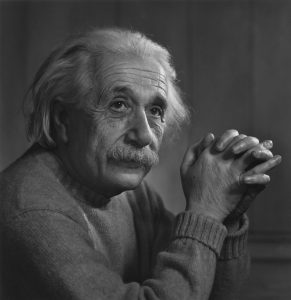
Yousuf-Karsh-Albert-Einstein-1948-02-1899x1960

Karsh, 1948. Albert Einstein

Karsh’s study of Albert Einstein (1948) is clearly a masterclass in portrait photography.

The image offers a limited range of values, off-whites through the greys with black being reserved for only the deepest shadows.

The subject is set against a background which suggests an academic setting. Separation of the subject from the background is achieved by shallow depth of field and by subtle illumination of the background.

Gradual transition from light to dark across the subject’s forehead and face suggests beautifully soft lighting, positioned to show the texture of the subject’s wizened skin.

Hands held in a relaxed yet classic contemplative pose, the subject’s eyes, whilst bright and alert, suggest that the sitter’s thoughts are placed elsewhere.

All this results in a portrait which is exquisite.

Applying Barthes (1977) method of analysis, Einstein is clearly the signifier, the signified being his quiet, unassuming and yet superior intellect.

The subject is photographed at a close social distance, the portrait is quite intimate as we are invited into the subject’s personal space. The angle of view suggests subject and viewer are of equal status, the eye-level image portrays neither a sense of superiority or inferiority on the part of the sitter.

Karsh’s trademark theatrical lighting provides the viewer with a reading path through the image which leads to the primary salient feature, the subject’s face, and the secondary salient feature, the sitter’s hands held in contemplative pose.

Once the viewer’s gaze reaches the salient feature, it finds the subject’s gaze makes no demand to engage, instead it makes an offer. Perhaps this offer is to look away from the trivial, the banal, the routine. Certainly, we are left wondering what images this great intellect is capable of seeing. What is in Einstein’s mind’s eye as he sits for this portrait?

So, what is the relevance to my photographic practice?

Whilst Karsh’s portraiture is far removed from the genre of food photography, there is some common ground: irrespective of the genre in which we practice, as photographers we all must understand the nature of light in order to craft it, to shape it, to manipulate it to reveal the true character of our subject.

By working in different genres, and as a consequence understanding how to manipulate light in differing circumstances, I am developing a valuable transferable skill which is only of benefit in my main area of practice.

Karsh’s portraits demonstrate his superb ability to get to the heart of his subjects, to identify their unique character. They also demonstrate his mastery of technique.

But they reach further still, revealing Karsh’s skill at blending empathy and craftsman-like technique to tell a story in a single image.


References:

Barthes, R. and Heath, S. (1977) Rhetoric of the Image in Image Music Text. London: Fontana

Berman, Eliza (2015). ‘Yousuf Karsh’s Masterful Portraits: from Churchill to Hepburn’. Time.com, 18 March 2015 [online]. Available at: http://time.com/3684569/yousuf-karsh/ (accessed: 04 November 2017)

MAYN Creative

Based on contemporaneous notes: 01 November 2017

A very significant point in my photographic career – first contact with a photographic agency.

An informal telephone conversation with Lynn Chambers of MAYN Creative, Falmouth University’s in-house photographic and creative agency, proved a very worthwhile investment of time.

The premise for my photographic practice was well received and I was grateful to receive professional advice.

Networking was identified as being key to developing my practice (being separate from the development of my photography).

Building relationships with food stylists, especially those who may be local, was encouraged.

Assisting food photographers, again especially any who may be local, was also strongly recommended.

Self-led projects were highlighted as being useful because they will extend my skillset in addition to gaining exposure for my practice.

Arranging meetings with potential clients, for example art directors or editors of regional magazines, was also suggested as a way of gaining exposure for my work, having my portfolio reviewed and establishing how individual publications go about commissioning work.

Given my specialisation, commercial food photography, developing my (existing) LinkedIn profile was identified as a good way of continuing to build my online presence.

Work is already underway to build a dedicated website for the business. A further informal discussion with MAYN is scheduled for mid-January, following up on progress regarding the above. At this point I will also be able to obtain feedback regarding the design of my website.

On Reflection: Week 5, Module Four

‘It is important to remember that numbers do not translate easily into significance. There is a tendency in content analysis and cultural analytics to assume that if something occurs very often, it is more important than something that occurs rarely’ (Rose, 2016).

As a concept, this can be applied equally well to how we measure not only the success of our images, but also the success of our marketing activities.

Is an image which is posted to Instagram and attracts 100 likes better than an image also posted to Instagram which attracts 1 like from a photographic agent?

How are we measuring the success of our images? And how are we measuring the success of our posts to social media?

If we post to a social media account and our image attracts likes, who is it that likes our images? And why?

As previously discussed, the old adage ‘horses for courses’ applies – is the best platform for a commercial photographer really a Facebook page? Or is an Instagram account which can be seen by agencies and businesses with commercial photography opportunities a better option?

Philosophically, if I pick up a camera and operate the shutter, does that make me a photographer?

If it does, at what point do I cease being a photographer?

On this basis, no level of skill is required and no quality of output.

By what name do we call someone proficient in the art of photography and having quality of output? Artist perhaps?

What is the quality that defines an artist and differentiates them from being a photographer if we take the above definition of a photographer to be valid?

Clearly the answer lies in much more than a name.

Prima facie, not all photographers are created equal …

What lies at the very heart of these questions (what underlies this line of questioning) is a desire to realise my identity …

Who am I?

What am I trying to achieve?

How am I trying to achieve it?

How successful am I being?

I am constantly trying to define (and refine) my identity …

Is my identity as a photographer separate to my identity as a person? Should the two be discrete?

This is fundamentally important because it relates directly to how I describe myself to potential clients (how I brand myself).

It is, therefore, a worthy investment of time.


Reference:

Rose, Gillian (2016). Visual Methodologies: An Introduction to Researching with Visual Methods. London: Sage Publications Limited

Marketing 101

Having been implemented several days ago, an initial ten-week marketing plan has started to yield some interesting results. Notably it has demonstrated my predictions regarding potential audiences for my photographic output to be accurate.

However, for my marketing activities to be most effective, a degree of realistic expectation is needed.

An all-important question is who could I potentially work for? Simple, basic. Yet there is a geographical consideration in order for this question to be answered in a manner which is meaningful from the point of view of running a viable business. Not only is the who important, where is also fundamental. Despite operating in the age of the digital image, advice garnered from initial discussions with a photographic agency is to focus on becoming established in one’s local area first.

Commercially, photography is a commodity and as with all commodities, there is supply.

Key questions here are as follows:

Who are the other photographers that work in my area?

Who else is supplying the clients in the applicable market?

Who are my competitors?

And because there is a supply, there is also demand.

Identify the amount of demand. Is there an overpopulation of photographers supplying the market earning a low share of the available revenue, or is there a small number of photographers supplying the market, taking a bigger share?

Having identified potential clients, the key is to reach them through targeted marketing activities.

Bowkett (2017) suggests that ‘photographers should choose where they would like to have their work displayed and develop that space to reflect their visual identity’.

Establishing a brand, the public image you present, is another fundamental requirement. Being consistent across a range of modes of presentation is essential to successful branding, as is adopting a professional yet stylish design.

It is this ‘visual identity’ which can be presented across the various social media channels.

Barthes referred to the contexts in which images can be consumed as “channels of transmission” in a tripartite system where the authors of images he describes as the “source of emission” and viewers become the “point of reception” (Barthes, 1977, p. 15).

Contemporary social media owes much of its popularity to its interactive nature where the community members are authors and contributors as much as they viewers and consumers. Images contributed to social media help individuals to define their online identity, where they “shape” the way in which others see them, where they portray themselves as they wish to be perceived, their “ideal”.

Social media is a dialogic form of transmission, meaning that there are many sources of information and many users, or to put this in terms Barthes would recognise, there are both many sources of emission and many points of reception. This is opposed to traditional forms of media which are monologic where the sources of emission are typically a very small number of powerful organisations delivering information to a wide audience.

From a marketing point of view, not all forms of social media are equal. One may be more beneficial to one type of photographer, to promoting one genre of photography than to another. Again, there is a need to be realistic.

Quality content – for photographers, this translates into having high quality images, is the obvious input to social media.

Tagging is necessary to create viral spread.

Regularity is also key. However, quality is again the overriding consideration, fewer quality posts are better than frequent low quality and irrelevant posts for the sake of posting.

But to assume these two activities alone constitute a successful social media marketing plan is a gross oversimplification.

As discussed previously, there needs to be a strategy.

And this needs to start with the question ‘which social media channels are the most appropriate to reach the target market?’

Commercial photography requires a more ‘no-nonsense’ approach to social media, for example, examples of successfully completed projects and behind the scenes shots, bearing in mind that behind the scenes shots build trust.

Stick to a plan diligence is key. Setting up accounts and posting regularly for a few days before the novelty wears off is a common mistake to avoid.

Successful social media marketing campaigns share certain characteristics. They begin by targeting a specific market, and avoid random posting.

Such campaigns also consider the value of interaction on social media. The best strategy is to engage with the target audience, for example, replying to comments.

Whilst engagement is valued, social media can be a black hole, try to limit time spent interacting on social media to, say, 20 minutes per day.

It is also beneficial, from an efficiency point of view, to identify which social media channels are most important, especially in the case of small businesses, and choose two or three maximum to concentrate on. Again, identifying the target audience, then identifying which social media platforms are most likely to be used by that audience is key.

The jewel in the crown, as far as marketing is concerned, is the website. The online presence for a business should be focused on the main target market, with all content being relevant to the target audience and their needs.

Only best work should be featured, even if this results in the gallery remaining small – ‘less is more’ being particularly apt in this instance.

In terms of operation, a website should have two main characteristics: these being that it is quick and easy to access. By analogy, a website is a shop window. Potential customers need access to the window if they are to view the goods on display. Any barriers put in place prevent easy access to the window. Simplicity is paramount when designing a website. Appearance and functionality go hand in hand.

Finally, a word on speculative marketing.

Businesses are curious regarding the appearance of their products look like and how they are perceived by the market. It is the need for such information that results in companies spend significant amounts on market research.

They are also interested in understanding the ways in which different photographers can portray their products.

Consequently, there is a lot to be gained by carefully targeting potential clients. This can be achieved by producing high quality images of products which are commercially available and sending them to the appropriate department within the product’s manufacturing company. This is an attention-grabbing way to potentially secure a meeting.

These, then, are the kernels of recommended best practice, the nuggets of advisory wisdom harvested from the internet which will bolster my marketing plan as I look to move forward over the forthcoming weeks and months.


References:

Barthes, R. and Heath, S. (1977) Rhetoric of the Image in Image Music Text. London: Fontana

Bowkett, E (2017) ‘Creative Brief’. The British Journal of Photography, Vol 164, Issue 7858 (April 2017), pp.84-85 [online]. Available at: http://ezproxy.falmouth.ac.uk/docview/1920352153?accountid=15894 (accessed Thursday 26 October 2017)


On Reflection: Week 4, Module Four

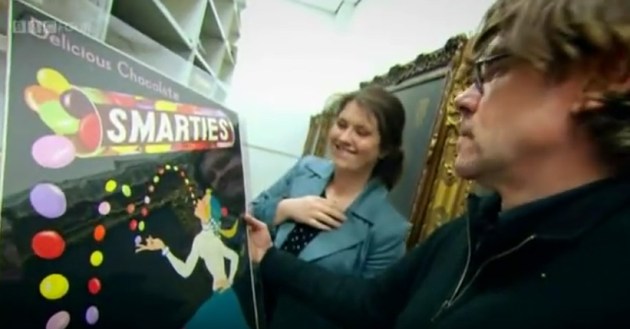
Slater_Archivist_Life-is-Sweets 2

Nigel Slater & Archivist Alexandra Hutchinson examine original Rowntree’s artwork

(Life is Sweets, BBC Four, 2012)

A week of decisions as the deadline for the module four assignments creeps closer …

I continue to be aware of the tension between commercial work and project work: trying to reconcile the differences and appreciate the similarities.

Photography as a tool for research in the fields of visual anthropology and social science is of increasing interest to me.

As much as I love food imaging my research has led me to question the function of commercial food photography, recently describing it as the art of persuasion. What does it offer beyond an open invitation to exchange money for food or drink?

From a visual anthropological point of view, contemporary food photography can be viewed as an invaluable source of information, recording the way we eat and our relationship with food for future generations.

5 November 2012, BBC Four and Nigel Slater guides us through the story of his life as recollected in sweets: toffees that inspired him to write a memoir, marshmallows and travel sweets which remind him of his mother and father respectively.

During the documentary, Slater outlines the growth of confectioners Rowntree and in doing so meets company archivist and historian Alexandra Hutchinson.

Together, they examine original artwork from the Rowntree archives.

Proof that commercial imaging plays a valuable role in recording our social history.

As is often the case, more questions than answers …

Who uses images? What are they used for? What is the life cycle of food images? Is there a different life cycle for images from a commercial perspective? And from a domestic perspective?

How do compare contemporary food images with early food images? How has food imaging evolved? How does food imaging fit into an historical context? And other contexts?

Rephotography is typically used as a tool to measure how geographical or architectural features change over a period of time with images being taken from an exact location, which is repeatable and reproducible, at pre-determined increments of time.

Food photography is different, the subjects being extremely ephemeral in nature and with no fixed coordinates to return to. By maintaining a record of how packaging evolves over time, food manufacturers are capturing important data in the same way that social scientists, geographers, geologists and architects are capturing data regarding glacial movements and the ebb and flow of urban developments.

There’s a lot to research in this area …


Reference and Image:

BBC Four/Nigel Slater: Life is Sweets (2012) YouTube Video, added by Elle [Online]. https://www.youtube.com/watch?v=q5Y5YIXJgs8 (accessed 09 November 2017)

A Photographer’s Sketchbook …

Brief: ‘create and implement an Instagram strategy that you feel will help you reach future, potential clients (whether ad agencies, curators or potential collectors), and then develop your account so you have 30 followers over the course of a week’ (Pfab, 2017).

An Instagram account has been set-up: philipmorrisphotography

Based on initial feedback from the operation of this account plus feedback from the ‘sharethesmarties’ viral image campaign, a successful Instagram strategy appears to include the following:

Key to (successfully) posting images is frequency, consistency and timing

The appropriate addition of succinct text to images

Use of hashtags – quality, quantity and frequency count

Following and being seen to follow other Instagram accounts.

Based on this strategy, appropriate metrics will be collected and analysed. The results will then be used to inform the Instagram element of a marketing plan extending into 2018.

‘Many photographers approach Instagram in much the same way they would a personal sketchbook, but one in which images are viewed publicly. In this sense, using Instagram can become a natural extension of their professional practice’ (Heinz, 2017).

I think Heinz raises a salient point. There are significant advantages to Instagram as both a marketing tool and a portfolio. However, there are significant disadvantages also, namely the loss of fidelity when an image is uploaded to the platform, and the fact that there is no direct means of loading images to the platform direct from a PC.

On this basis, can it be much more than a sketchbook, a tool for recording moments of inspiration for future reference?


Reference:

Heinz, Lauren (2017), ‘5 Instagram Lesson from Magnum Photographers’, magnumphotos.com [online]. Available at: https://www.magnumphotos.com/theory-and-practice/instagram-lessons/ (accessed: 19 October 2017)

Pfab, Anna-Maria (2017), ‘Sustainable Prospects’: Instagram. Falmouth: Falmouth University [Online]. Available at: https://flex.falmouth.ac.uk/courses/84/discussion_topics/2794 (accessed: 19 October 2017).

A Marketing Plan

Week 4, Module Four…

The brief: ‘create a marketing plan for your practice which covers the next 10 weeks’ (Pfab, 2017).

Fundamental to developing a marketing plan has been to define the business offering. In line with this an Artist’s Statement has been developed. This will feature on the about page of a website (currently being developed) in addition to other promotional literature.

The goals of my 10-week marketing plan are as follows:

To establish and raise a profile within the photographic industry and within the wider community

Prepare the legal and financial framework required for effective business management and metrics.

The objectives which will facilitate this are as follows:

Establish a brand across a range of formats

Develop industry specific knowledge appertaining to contract and copyright.

Strategy:

Design, develop and launch a website

Increase the number of Instagram followers to 300 (30/week over 10 weeks)

Establish a Facebook page for the brand

Post (a minimum of) 3 images per week to the social media platforms

Add (a minimum of) 10 images to my commercial portfolio (programme of constant renewal)

Preparation of business documentation (e.g. estimates, invoices, receipts, terms, etc.)

Research and join at least one professional organisation (e.g. Royal Photographic Society)

Research and subscribe to at least two networking organisations

Arrange and hold discussions with at least one photographic agency

Research and subscribe to at least two sources of industry specific news

Design business cards, outsource printing.

The marketing plan will cover the ten-week period commencing Monday 16 October and ending Sunday 24 December 2017 (inclusive).

Appropriate metrics for the various platforms will be collected and analysed.

A marketing plan for a further 13-week period (01 January to 01 April 2018 inclusive) will be developed using the results of this analysis. The expectation is to rollout four 13-week marketing plans during 2018, and two six-month marketing plans per year thereafter.


Reference:

Pfab, Anna-Maria (2017), ‘Sustainable Prospects’: A Marketing Plan. Falmouth: Falmouth University [Online]. Available at: https://flex.falmouth.ac.uk/courses/84/discussion_topics/2797?module_item_id=6502 (accessed: 18 October 2017